
Remake
Season 39 Episode 6 | 1h 54m 55sVideo has Audio Description
A filmmaker father tries to make sense of the sudden, unfathomable death of his son.
Ross McElwee has shot footage from his own life since the 1970s. His son, Adrian, was born into this practice, and was filmed from infancy into his difficult older years, through his death of an overdose at 27. Remake asks questions that could only come after: What did the camera capture, what did it miss?
See all videos with Audio DescriptionADProblems playing video? | Closed Captioning Feedback
Problems playing video? | Closed Captioning Feedback
Major funding for POV is provided by PBS, The John D. and Catherine T. MacArthur Foundation, the Wyncote Foundation, Reva & David Logan Foundation, the Open Society Foundations and the...
Remake
Season 39 Episode 6 | 1h 54m 55sVideo has Audio Description
Ross McElwee has shot footage from his own life since the 1970s. His son, Adrian, was born into this practice, and was filmed from infancy into his difficult older years, through his death of an overdose at 27. Remake asks questions that could only come after: What did the camera capture, what did it miss?
See all videos with Audio DescriptionADProblems playing video? | Closed Captioning Feedback
Where to Watch POV
POV is available to stream on pbs.org and the PBS app.

POV Playlist
Every two weeks, we curate a selection of POV docs, old and new, around a central theme. Stream while you can — until the next Playlist!Providing Support for PBS.org
Learn Moreabout PBS online sponsorshipMore from This Collection
POV Broadcast Feature Films.
Video has Audio Description
A Midwives' arrest ignites Amish and Mennonite women to fight reproductive justice. (1h 16m 46s)
Video has Audio Description
Two Nairobi women transform what was a whites-only library until 1958 into a vibrant cultural hub. (1h 22m 45s)
Video has Audio Description
An intimate portrait of a complex father-daughter bond and the immigrant working class in America. (1h 22m 43s)
Video has Audio Description
Kalief Browder’s everlasting legacy expands via the poetry of his mother, Venida. (1h 23m 1s)
Video has Audio Description
With 30 million excess men in China, three bachelors join a dating camp for love. (1h 23m 27s)
Video has Closed Captions
A Korean birth mother and her daughter struggle to stay reunited for the long haul. (1h 22m 58s)
Video has Closed Captions
Poet and activist Staceyann Chin chronicles her journey of healing, forgiveness, and mothering. (1h 23m 5s)
Video has Closed Captions
Confronting war, Ukrainian artists pick up arms while finding strength through art. (1h 22m 41s)
Video has Closed Captions
A small-town attorney takes on pharmaceutical giants as opioids devastate his community. (1h 22m 48s)
Video has Closed Captions
An environmental thriller that shines new light on the human cost of coal. (1h 22m 58s)

Video has Closed Captions
In rural Mexico, a community seeks answers, uncovering alarming truths about their water. (1h 14m 47s)
Video has Closed Captions
A family’s free life in nature is disrupted by tragedy, forcing them into modern society. (52m 53s)
Providing Support for PBS.org
Learn Moreabout PBS online sponsorship♪♪ ♪♪ -Next on "POV" -- Exposing both the bond and the barrier the camera forged between them, filmmaker Ross McElwee tries to make sense of the sudden death of his son.
"Remake" on "POV."
♪♪ -Stay tuned following this program to hear from the director and to find out how you can share your point of view.
[ Waves lapping ] -I used to call myself a filmmaker.
A documentary filmmaker.
Although my films touched on broad issues like nuclear weapons proliferation or big tobacco, what was central to my films was always what was happening in my own life, often involving my family.
And you, Adrian, were a big part of that.
-Can you cut a piece for me, Dada?
-Most of the time when I was filming scenes like this one, I didn't really have a purpose in mind.
But I always did imagine that someday, I'd watch some of them with you.
Say, when you were in your mid-thirties and had kids of your own.
-Daddy, it can go backwards, Dada.
-You ready?
-Yes.
-You made the little trap yourself.
You once said it was like flying a kite except it was underwater.
-Whoa!
-How many did we get?
-Whoa!
-That is a big one.
-That's the biggest one we ever caught.
-I think so.
It is huge.
-Do you think we should let some crayfish go?
Yeah, I think we should.
-Because this big one might be really angry.
-He might be.
It's big, Adrian.
I filmed you spontaneously, randomly, just a few minutes every month or so as you were growing up.
But as the years went by, it added up to quite a bit of footage.
-I got something!
I definitely got something.
-Great!
-I can probably use that for bait, Dada.
-Maybe.
-[ Laughs ] -Hey, it's a little one.
Why do you think you like fishing so much?
-I don't know, I just love... the deep surprise of the ocean.
You never know what you'll catch.
"Adolescent."
And adolescence is going through... An adolescent is going through adolescence.
-That's exactly right.
-Which is the... Yeah, that's good?
-Yeah, that's good.
Now, as I look back over that footage from those years, I found a partial record of what was happening in our lives then.
What you were up to, and -- and what I was up to and how we were both moving closer to the day that you would die.
I look at this footage both to convince myself that you were alive, but also to convince myself that you're gone.
It's been seven years since you died.
And I still miss you every day.
♪♪ ♪♪ ♪♪ ♪♪ -One from up here and one from down there.
-This is Adrian with his mom, Marilyn, in the film I called "In Paraguay."
"In Paraguay" touches on various subjects, like the devastation caused by a series of disastrous wars initiated by Paraguayan dictators.
-Hey, hello.
Hi.
I have your picture.
-But it mostly dealt with the complexities of foreign adoption.
We were in Paraguay to adopt our daughter, Mariah.
-Es demasiado.
-Acá pone, acá.
Acá, acá.
-Could you say, "We need some more dirt"?
I mean more...more bricks.
Más, más piedras.
Que no se caliente.
-We ended up being stuck in limbo in Paraguay for three months during the adoption process, and I found my camera gravitating more and more towards my son.
-This is a restaurant house.
-Oh, a restaurant house.
-There's even a bed.
One minute.
What would you like to eat?
-Um, do you have any, um... um, patatas fritas?
-Sit down and go over there.
I will be there in a second.
Serve yourself salad, please.
Serve yourself salad.
-Mmm, tasty.
-Even then, I could see that this was, for me, a kind of golden period of family life and of filming.
-Boy, is this delicious.
Ooh, sorry.
[ Laughter ] -Boy, that was good.
-Don't... Mom, it's a while to eat that!
-I gulped it.
I'm sorry, I was starving.
-I was a pig, eating a pig.
-You can't -- -Hey, waiter, my steak is as hard as a rock!
-No, it isn't.
I was in love with my wife, in love with my kids, and in love with the pleasure and practice of filming moments in life that unfolded before the camera.
¿Pero qué país es?
Los Estados Unidos.
-¿Estados Unidos?
-Sí.
Sí, sí, sí.
[ Laughter ] -[ Indistinct ] -Se va a hacer modisto.
-Sí.
No es, no es fácil.
[ Laughter ] [ Applause ] "In Paraguay" premiered at the Venice Film Festival.
Venice was a great way to premiere the film.
But as it turned out, further screenings were postponed indefinitely until my wife and I could come to terms with putting another chapter of our family life in public.
-Bravo.
Bravo.
-Bravo.
Bravissimo.
Bravo.
-It had already taken me years to finish "In Paraguay."
And as the years went by, things at home became more and more strained.
Marilyn had made it clear that she preferred not to be filmed anymore.
And with the kids now in their teens, that seemed to be more or less the feeling around the house.
Mariah?
-Please may I touch it?
-Wait a second, honey.
-And then I will touch it?
-Tell me what you did.
-I did pee-pee.
-Did you really?
-Yes.
-Upstairs?
-Yes Let me touch it.
-Over there?
-You can touch it here.
What do you see?
-Rainbow.
-A rainbow?
Mariah?
What page are you on, sweetheart?
-I have to go find out.
-Somehow, the so-called golden period of filming moments from my family life seemed to be coming to an end.
[ Up-tempo hip-hop musi playing ] Adrian, I asked you to keep the sound down until I finished filming.
-It is down -[ Volume decreases ] Don't film me right now.
Dada, I'm gonna make something for you as a present.
-Oh, good.
-It's called a Cooking TV.
-What's a Cooking TV?
-It's the good kind of TV, not the bad kind that makes you stupid.
It's the good kind.
-Where do you see the image on it?
The picture?
-Well, the image is on the paper right here.
But it's like a puppet show.
Not very like a puppet show, but a little.
And I go behind it and then I talk.
Then the story comes true.
But I have to write something on there at the end.
[ Beeping ] I love you, Dada.
-I love you too, honey.
-You're so cute, Dada.
Is that gonna come on the film?
-Probably.
-Why do you say "probably"?
-Whether I edit it out or not.
-What?
-It depends on whether I edit it out, cut it out of the film.
-I want you to keep it on.
-Okay, I'll keep it on.
-[ Shouts indistinctly in distance ] -Okay!
-In nearly all my films, my family life had been the lens through which I've tried to make sense of the world around me.
In fact, my mother's favorite expression was, "Everything begins and ends with family."
But although my kids had loved being filmed and I had loved filming them, they'd apparently had enough.
[ Phone ringing ] [ Ringing continues ] I wasn't sure where to go from here.
Until I got a phone call.
I have to be quiet, though, because my father's asleep upstairs, and, um... You know, I think he already has enough questions about the validity of my film project without... seeing me dressed up like this, talking to my own camera.
-Hi, sis.
-Hi!
-Where's Dad?
Oh, he's way back there.
The call was from a Hollywood producer who was interested in trying to remake one of my documentaries as a fiction film.
I made "Sherman's March" back in my mid-thirties when I was still single, and my family and friends were starting to become concerned about my singleness.
-Hello, Dede.
-Hi, I'm glad to meet you.
-Glad to meet you, too.
-Hi, I'm glad to meet you.
Charleen has -- to say the least, said a lot about you.
-Oh, and about you.
[ Laughs ] -Would you stop?
Would you stop?
-Don't touch that lens.
-Stop.
I can't help but touch it.
Turn it off!
This is important.
This is not art, this is life!
-Alright.
-[ Speaks indistinctly ] -"Sherman's March" was the film where I found my footing as a filmmaker by making the decision to film things that were happening in my own life.
[ Monitor beeping ] I come from a family of doctors -- grandfather, father, and brother.
-Go down.
-Isabelle.
-Yes?
-Good morning.
-And at first, my way of making films seemed a little strange to them.
-I'll be glad when that big eye is gone.
-But eventually they got used to it.
[ "Respect" playing ] -♪ Oh, a little respect -Making "Sherman's" had been an adventure, a road movie in which I didn't know where the road would lead.
But I did manage to meet a few women along the way.
-♪ R-E-S-P-E-C-T ♪ Find out what it means to me -Now that there was an offer to remake "Sherman's March," I felt somewhat protective of my film.
I decided to talk it over with my sort of trusted advisors -- my brother and sister.
-I think it's a wonderful movie, and I think it deserves to be on the big screen.
-It was on the big screen.
-Bigger screen.
-Can a movie bomb twice?
[ Laughter ] -Tommy!
Be nice.
-I think it's a very bad idea.
-Really?
You really think that?
-Mm, depends on how -- on what he does with it.
-Well, that's my concern, too.
You know, can he make a good film from this?
-But if you have some kind of control on that and they say you're going to be one of the producers, then maybe it'll work.
-Yes, that's a very, very intelligent thing my brother just said.
-Well, I'm a doctor.
-He's a doctor.
-What do you expect?
-I'm an animal activist.
I train the wild beast!
Yes, I work with animals.
Hey, hey.
-So how are you gonna control this guy to -- so I won't be readin The New York Times Friday movie review thing -- "Ross McElwee sold his soul"?
-Yeah.
One star.
-One star and a half.
-Maybe.
-Well, they'll let me have some input.
They want my input in constructing the script, writing the screenplay.
-Well, that sounds good.
-Yeah, I don't really think they have a clear idea as to how they're gonna do it.
-I do think if you decide not to do it, then you'll always second-guess yourself.
-Yeah.
-Well, I'm taking the first step.
-You'll always wonder.
What?
-I'm taking the first step.
We'll see what happens.
-I think that's a good idea.
-I went to Los Angeles.
A meeting had been set up for me to talk with Steve Carr, the director of a string of commercially successful comedies.
When did you first see "Sherman's March?"
-The first time it played on PBS I was in -- living in New York, and it played on channel 13, which is the New York affiliate for PBS.
And I guess I was waiting for "Monty Python's Flying Circus" to come on, and I stumbled onto it.
And I remember my mom was watching it, too.
And, um... I caught it at the very beginning and it just unfolded for me.
-You think anything of it really has anything to do with your lifestyle, like you were talking about?
The way you dress, the way you live?
-And it was a world I hadn't seen.
And the characters just seemed to, one on top of the next, become more and more interesting to me.
-[ Grunts ] Come on.
Come on.
Now, you got to stay in.
No!
No.
Sit.
Sit.
-And then I got -- I got caught up in your likability and the journey.
-On February 16th, 1865, Sherman's troops massed here on the banks of the Congaree River.
-I got the opportunity to see it quite a few times initially.
And then it always just stuck with me and I always loved it.
And didn't see it for years and years but always remembered it and would talk about it with friends.
And then when Jason and I got together, I've always had this idea about the movie that I thought this could be, and it always included every bit of the documentary that I've seen and that I cherish, and now the experience I have of actual filmmaking and how to tell the story of a film being made.
-I am bored with your singleness.
-Well, I've made attempts at correcting this situation.
-Yeah, well, see, that's the other thing that's boring is failure.
-Charleen wants Amy Adams to play her.
-That's -- yeah, she's great.
-She's actually on our list.
-Is she really?
-Yeah.
She was actually on our list for... -She's on almost every one of our lists.
-Yeah, yeah.
-She's great.
-Oh, my God, the best.
-My son, Adrian, wanted me to give Steve and his team a crack at turning my old film into a work of fiction.
It was kind of a running joke between us.
He'd say, "I like your documentaries, Dad, but it's time to make a real movie."
He was becoming more and more interested in filmmaking as a possible career.
And it did occur to me that maybe the remake of "Sherman's March" might also open a door for him to enter the world of what he called "real movies."
Does it look okay through the viewfinder?
-It is what it is, Dad.
-It's what it is.
-It's a still shot that you picked out yourself.
-I finally agreed to sell the rights to "Sherman's March."
And in turn, I secured the rights to make a new documentary about the fictional remake of my old documentary.
I asked Adrian if he'd like to film his dad signing the contract.
-I'm saying that I'm surprised you don't at least want a slow zoom or something.
-Go ahead and do a slow zoom.
Well, let me sign this, and then you can do a slow zoom.
-It's boring to have it running.
That's the kind of shots you can get when you're filming yourself.
The point of having a cameraman, is you can actually get... ...a more interesting shot.
-Okay, take the camera off the tripod and get a more interesting shot.
-I don't want to take it off the tripod.
-Well, move the tripod.
-Alright.
-That is so peculiar.
I cannot believe it.
It's so peculiar.
-The irony of "Sherman's March" being undertaken by somebody else.
-Who is it that made that decision, and how can we escape him?
-No, I don't want to escape him.
I want him to succeed.
I think, you know, if he can make a really good independent fiction film from "Sherman's March," I'd be elated.
I just don't quite know how it can be done.
-I mean, I'm saying that I can't be replaced.
Neither can you.
And it'll be hilarious for us to see people try.
-Charleen Swansea is one of my oldest friends I met her in high school when she was teaching a poetry workshop.
-You know, I learned a lesson from the Ezra Pound debacle, which is that it didn't... matter.
I mean, it didn't matter what Ezra Pound thought.
-Charleen has been there for many of the important moments in my family life.
-What do you think?
What do you think?
Adrian, what -- hi, darling!
[ Laughing ] [ Laughs ] -[ Laughter ] -Where are you?
-This baby has got so -- This is such a smart baby!
-He's been around a camera a bit.
-That's not what makes him smart.
Being around a camera makes you stupid.
This is a smart baby.
So, I'll come in on August the 8th, and if I'm not gonna come in on August the 8th it would be because I'm on so much medication that it's really hard for me to think ahead.
And I hate to do the tests that you're gonna do on memory when I can't remember my name let alone some questions that you would be asking me.
They're testing... ...old people about how accurate their memories are.
-But it's part of a scientific, data-driven study?
-Yeah, it's a long -- it even has a name.
I can't remember the name of it 'cause I didn't care.
And that's how you remember something.
You care about it, usually.
Anyway... [ Laughing ] What did you ask me?
-How is your memory, Charleen?
Speaking of memory.
-I don't know.
It's too complicated.
It's like a beehive.
-But do you find that your short-term memory is holding together okay as you get older?
-No, of course not.
-Oh, boy.
Mm.
-I can remember odd pieces of stories and things about -- things I remember about you.
[ Camera whirring ] They just pop up.
I don't know.
That's how memory is.
It just -- it surprises me.
[ Bell chiming ] -You filming?
Is it filming?
-Yes.
-Bravo, bravo!
-Bravo, bravo.
Looking at this now, you seem as alive as ever... in a kind of half-life that now represents you.
I mean, you're alive here in this footage, but you're no longer alive in the real world.
Where's your favorite place that we've been to, Adrian?
What about Munich?
-Well, that was nice.
-We were only there for one day.
-I was?
-Mm-hmm.
-Munich Film Festival.
-That's right.
Remember?
-And that's the place where the film had a problem.
-That's right.
It got all confused because they put the wrong numbers on the leaders.
-What happens when you do that?
-Well, people can't tell which reel comes first.
-Because what if you put a two here and you put a one at the end?
-Mm-hmm.
That's sort of -- that's what happened.
And it took them a long time to get the leaders straightened out.
The story I thought I was telling with my filmmaking, the story of lives lived over decades, is now disjointed.
[ Piano music playing ] Confused.
[ Beeping ] -Let go.
-The reels are all out of order.
First, there is a father, and he has a son -- me.
But then it starts all over.
I am now the father, and I have a son -- you.
But something goes awry, something goes off script.
And then suddenly you're gone.
Did you like the wedding scene?
-Yeah, I love that part.
-That's your favorite part?
-I love when you get married with Mama.
-You think you might want to get married someday?
-With you.
With Dada and Mama.
-[ Chuckles ] Only with Mama or Dada?
-Mm-hmm.
Mama and Dada.
Only Mama and Dada.
-So, yes, you're gone.
Except you're not gone.
Not entirely.
Because I still have all these moments with you I captured on film.
Adrian...I know you think that I should be working for a Hollywood production.
-You can, though.
That's why I don't understand it.
I mean, I just don't... Like Steve Carr does.
He works on the moneymakers first.
Then now he has time to do whatever he likes and he doesn't have to worry about money.
-So you want me to be more like Steve Carr?
-Well... -But, Adrian, I'm trying to do films my way.
-Yeah, but it's not always about -- no one always gets their way.
Sometimes you have to make -- just like you said to me, you can't, you know -- I'll have to -- you can't just start at the top.
You might have to be someone's coffee bitch for a while or file paperwork or run little errands in a trailer before you -- for a couple of years before you even do anything meaningful.
And so plenty of people do stuff like that.
So I don't see why you're above that.
-But I've done that.
That's how I began my career.
-And you've been successful, but I'm saying, why not just do some blockbuster hits or -- -Adrian, it's not as if I can just opt to do a film that's -- -You've been offered to do commercials for Jaguar you turned them down.
-Well, that was years ago, Adrian.
-Why would you turn something like that down?
That just doesn't make sense to me.
-Because I didn't want to do TV commercials.
-But it's not always about what you want to do.
You're the blessed -- it's such a spoiled attitude to have.
-Had to get that out of the way.
-[ Laughs ] -Ow!
I told you that was my worst fall.
-Yeah, good job, Adrian.
That was good.
-I'm done.
I almost hit you in the face.
I'm gonna do something big, and it's not gonna be... It's not gonna be from a degree.
I'm not gonna graduate with a degree in English or film and do this and that.
I would love to work for HBO, for example, or an internship for, you know, Steve Carr and get involved in that project heavily, and then maybe they really like me and I move up one position more and then one position more.
You know, that's how it happens.
I understand that.
But on my own, I think it's gonna be through a book I've been trying to write.
It's based on my life and my experiences, and I've had a lot of ridiculous experiences, so... -And weren't you working on a screenplay based on the novel?
-Yeah.
But then again, I also... I came up with this company, None Higher -- nonehigher.com.
It's up.
You can check it out.
Right now it's just basically a music blog.
But my ultimate goal is to have a line of T-shirts.
Once again, another thing I'm procrastinating.
♪♪ -At the time, Adrian was pursuing multiple projects in multiple fields, but almost all of them seemed to connect back to filmmaking.
-What?
-Hi.
-Hey.
-Can I watch you?
-Yeah, sure.
[ Engine rumbling ] -Yeah.
-Oh!
-Be careful.
-I know.
-Okay, I can't really do it but, you just go like... When I have all my protection stuff, you go like this, like this.
-Yeah -Like that, like that.
And then I can turn it around like that.
-That's pretty sick.
-Yeah.
Like that.
♪♪ ♪♪ ♪♪ ♪♪ -Oh, sorry.
-It's okay.
Two, three.
Alright, cut.
♪♪ ♪♪ ♪♪ ♪♪ -So I went back home, back to the South.
The people producing the "Sherman's March" remake asked me to record narration they had written for a sample reel.
It would be composed of actual shots from "Sherman's March."
They've already set me up on dates with a few nice women, and I've been looking at some of my... Take two.
They've already set me up on dates with a few nice women, and I've been looking up some of my ex-girlfriends as well.
I'm holding out hope that romantic love is still possible here in the modern South.
A few weeks later, they sent me the finished sample reel.
-So I went back home back to the South.
[ Beck's "Loser" playing ] -Leave us alone.
You better leave us alone.
[ "Loser" playing ] -The fiction film as you -- as you know of it and how... Steve and his team in Los Angeles had struck a deal with a well-known cable television network.
Rather than a feature film, the idea would now be to adopt "Sherman's March" into a dramatic television series.
Oh, well, TV would be fine.
Gosh, I don't know where it stands right now.
It started off as a narrative feature.
It then morphed into a series.
-Right, the AMC -- -That's right.
With Steve directing the pilot and ... I was beginning to have my doubts about the whole project.
I needed to be back in the world I had filmed to remind myself that my friends were real people living real lives, not actors following a script.
[ Music playing on TV ] -Does it look the same?
-Oh, I see it.
Oh, neat!
Oh, neat.
It is 3-D.
-As Steve and the network began talking to writers, I decided to go back to North Carolina.
I had learned that my friend, Phillip Osborne, who had appeared in "Sherman's March," had died.
-Tension that up?
-Yeah.
Now put it back on there and see what happens.
-Okay, great.
-I bet you it'll work just great.
-Yeah.
-Phillip's son, Phil Jr., had taken over the family business.
Phillip?
-Good to see you!
How you been doing, Ross?
-I'm okay, Phillip.
-Great, great.
-Great to see you, man.
-Good to see you!
How about that?
There's a fella here in town that owns this one now.
-You never wanted to drive one around yourself?
-I do have some old British cars.
I have an old Bentley that I drive, so I enjoy it.
-You drive a Bentley?
-Yeah, I have a 1952 Bentley Mark VI.
-You're doing pretty well.
-[ Laughs ] -Well, actually, it was my father's car originally and I inherited it.
We lost him in October 2010.
And he said that he was very, very, you know, content.
He was, you know, happy with the life he had lived.
And when we come in here, we say he still lives because of the things that we've done together, the things that we used to do, and the things that we have a lot of great memories of.
-That's right.
-Do you remember taking off my steering wheel?
-Sure, I do.
Well, you know, that was one of the safety features, as they used to say, for keeping your car there.
[ Laughs ] See?
You take your steering wheel off with you.
[ Chuckles ] Take it off with you and go anywhere you want to go.
-Take it on in the house.
-Mm-hmm.
-That's right.
-That way nobody can steal your car.
-Philip does a lot of work now himself.
-Oh, yeah, I saw him.
-You only have one son, right?
-Right.
-One son and one daughter now.
-Yeah.
That's such a shame about your daughter.
-Yeah, it was something... -Sorry to hear about that.
-Yeah.
But that's just one of those things that'll happen, though.
Yeah, I think about that girl.
I miss her too.
-Yeah.
-I really do.
Yeah.
-How did she die, Phillip?
-She had cancer.
-Cancer?
-That's bad, bad.
-That's alright.
Your mother had cancer, too?
-Yeah, she had cancer also.
-Yeah.
-My mother always encouraged my hopes of becoming some kind of an artist.
But she died when she was young, long before I became a filmmaker.
I went to visit my family's burial plot in Charlotte but discovered that my mother's headstone had mysteriously disappeared.
Oh, there it is.
-And obviously this one has been quite a while.
You can see the lettering in the... -[ Speaking indistinctly ] -You're spinning very slowly, but you're not gaining any ground.
This hippie lifestyle just has... -Not a hippie lifestyle!
-It is a hippie lifestyle.
-No, it's not.
-In New York and Boston, you can get on the subway and ride to the beach, you know?
And here you have to drive through five miles of miserable, swampy, muddy road, be attacked by mosquitoes, and you get stuck in the mud for all your trouble and then you have to walk back.
-And you never get to the beach.
-While down South, I visited another friend who had appeared in "Sherman's March," Wini Wood.
When we were making "Sherman's March," a lot of random moments got filmed, you know, from your life here.
-And those exist now in a film.
-[ Chuckles ] -What do they seem like to you now, 30 years later?
-Well, now it's odd that the film is a kind of memory archive for me.
It's -- you know, I remember what it felt like being at Genesis, and I remember a lot of things I did.
But for me now, looking at the film, it's how those memories become -- I mean, they're really activated.
When I watch me milking a cow, I can feel the sensation of the cow's udder.
I can feel what it's like to touch and smell a cow.
So it really activates memories.
It functions as memory.
And I can see this as you're making your other films, as you're getting older and trying to retrieve those memories.
Because we become more acutely interested in memory as we get older, I guess.
You know, memory is also partly about connecting the past to the present.
-What is this?
-This some war trash, honey.
I'm trying to remember what you said that irked me so because it is so absolutely, totally the wrong thing to say to a woman.
I don't remember making movies together.
-Really?
-I really don't.
-Mm-hmm.
-What movies would we have... -Well, I made a movie called "Sherman's March."
You were in it, and you were great in your role in that film.
People loved it.
-I don't remember the... -I don't remember it.
-Really?
You don't remember when you went with me to a military bunker near your house?
-I mean, what you say to a woman is not self-effacing.
I mean, that's not -- that's not even interesting, let alone-- -I never met her before.
-I don't care.
Ross, I'm trying to tell you.
-I didn't want her to postpone a vacation because I was coming into town.
That's absurd.
-Ross, that's what's wrong with you.
What she wants to hear -- what all women want to hear, what children want to hear -- you've got to be more passionate, Ross.
Now, if you had said to Dede, "Please postpone your vacation..." -You talk about a passion being necessary to have a meaningful life.
-I don't care, Ross!
I'm telling you!
-It's a scene that resonates, and I think people have really appreciated it over the years.
You don't remember that?
-No.
Not anything about that.
No, what I remember about you and I together is not that.
It's um... I feel like I can make you laugh.
-This place is like a tomb.
-No, it's not.
It's like pubic hair.
Part the bushes!
Go into the place!
Go with it, Ross.
It's not like a tomb.
That's the trouble with you.
You don't know the difference between sex and death!
-Sex and death?
-Sex and death!
-This is life!
-One and the same.
-You can't even tell it when it sits on your face.
You can't tell which it is.
-And you also make viewers, audiences laugh.
And you used to make us laugh in the classroom.
-Classroom?
What classroom?
Fred, stand here with me.
I want you to be my lover for a minute.
I want y'all to imagine that... -You were a teacher.
You taught poetry to high school students.
-To what?
-You taught poetry.
-You want to say what you feel so the people know it and give it back to you.
Okay, I got to say what I feel to this man I'm in love with him because I got to make him love me back.
Now, I can talk to him one of two ways.
Freddy, look at me.
I love you, Fred.
[ Laughter ] -Do you remember the Poetry in the Schools program?
That's how I first met you.
-I don't know, but things just disappear.
-Mm-hmm.
-They just disappear.
[ Chimes sounding ] -Charleen.
-"One day, Adrian told his parents, Ross and Marilyn, that he wanted a baby sister to play with him at the beach."
-It was me?
-Yes.
-"Then one day, they heard that in a country far away, called Paraguay..." -When my wife and I decided to separate, I moved into a sublet not too far from the house.
A trial separation is what the court called it.
My son was in Vermont, attending college.
His sister stayed at home with her mom.
And suddenly I was living alone.
My wife and I worried about the effect the separation would have on our children, but we didn't worry enough about it to prevent the separation from happening.
And then suddenly my son was back in Boston, living with me.
In Vermont, he'd ended up in a hospital emergency room.
He'd gone to a party and overdosed on vodka and the drug Ecstasy.
His mother and I had rushed to Burlington.
We'd been through this before.
Adrian had had flare-ups with alcohol and drugs, binge drinking, being expelled from high school for marijuana possession.
We'd sent him to a wilderness program in Utah for kids with substance abuse issues, and we found therapists and psychiatrists to try to help him.
But whenever we thought things were maybe getting a little better, a new crisis would happen.
[ Lil Wayne's "Bill Gates" plays ] -[ Rapping ] ♪ Yeah ♪ Unh, skinny ass pants ♪ Fresh pair of Vans ♪ If them...keep trippin' they can share an ambulance ♪ -Adrian, I'm totally supportive of you writing and you filming -- -But you don't really believe in any -- I believe, between the Internet, filming, writing, and creating a clothing brand, I would be very well off and I'd be happy with my life.
-Right, but you're undermining yourself by all of this other behavior.
Like what happened last night, you know?
Why do you do those kinds of things?
-Why?
-Because I just... I don't know.
-You're gonna hurt yourself drinking and -- -I didn't drink anything last night.
-Well, not last night, but... You did something with some drugs last night, and you know, you could really hurt yourself.
-Well, it's always a risk.
So is skiing.
So is driving.
It's not like I'm shooting up heroin.
-No.
I'm thankful for that at least.
Go work on your résumés and get them in.
I'll go get some ice coffee.
-Can you give me a venti or whatever it is?
The largest one.
-Yeah.
-Can you get double espresso shots?
-Yeah.
-Just want some caffeine, okay?
-Okay.
-Go cut your toenails at some point.
I was worried about my son's risky behavior with drugs and alcohol.
But suddenly there were issues of my own to deal with.
-After your MRI, the radiologist called me and said, "I'm calling you about, Mr.
McElwee, your patient."
He goes, "Wow, is he having any symptoms?
He's not having headaches?
He's had no neurologic symptoms?"
I said, "No, I was just looking for pressure."
See?
This is what I'm looking at.
It's putting pressure on his brain has kind of collapsed part of the ventricle.
But you can see it here.
You can see how huge it is.
It's a very important part of the brain that there could be neurologic consequences as well.
I mean, it's your brain.
-Chances are I'm gonna survive it.
That seems... -Almost certainly you're not going to die.
-We basically go down the midline... to the tumor in that little opening that I mentioned to you... and then literally take the pulp out of the tumor and then bring in the "rind" of the tumor, if you will, so that we get all the tumor out.
But then we put that dura -- the covering -- back, stitch it back.
And then we put the bone back in with little metal plates and screws, and then we put the skin and scalp back on, and stitch that back up, let you heal.
-So tell me, Ross, in your darkest hours, what do you worry about?
-Well, I do worry about something freakish happening and me dying.
And Adrian having not straightened himself out.
-Right.
-I worry a lot about that.
Adrian remains a question mark.
I think he'll be fine, ultimately.
But I don't want to leave him now.
I really don't.
-Right.
[ Hammering ] -I mean, a lot of people would look at this -- this nice construction that this neighbor of mine is making and just think of it as a flower box.
I mean, after all, spring is coming and the flowers will still be in bloom and -- but I look at it with my surgery two days away and I think it's a coffin.
It's a box.
A coffin for a human being.
But for God's sake, this is all morbid.
There's a 95% chance of success with this operation.
So why do I dwell on the 5%?
Why?
I think it's because there's a 5% chance I won't see my daughter again.
Mariah continues to be such a joy, such a sweetheart, and I would really miss her.
And a 5% chance that I won't see my son.
It's been difficult the last two years with Adrian.
He's 21.
He's got all kinds of problems.
But the kid also has tremendous skills and abilities, and eventually he'll figure himself out.
So all of that is figuring into this very complex equation now as I think about the next 48 hours.
[ Hammering ] [ Footsteps ] [ Door opens ] [ Monitors beeping ] [ Hammering ] [ Chimes sounding ] [ Monitors beeping ] [ Chimes sounding ] [ Chimes fade ] A week after my surgery, Adrian smuggled a small video camera into my hospital room.
He said he thought it would help me recover faster.
I remember being thrilled to be filming again.
I mean, you'll never know what you'll get.
The deep surprise of the food tray.
It meant a lot to me that Adrian would bring me the camera, and also that he took charge of sending out bulletins to family and friends to let them know of my recovery progress.
I was finally allowed to come home from the hospital.
My wife and I put the divorce on hold.
During my rehab, I'd learned that Adrian's psychiatrist had diagnosed him with bipolar disorder and had prescribed lithium to treat it.
Adrian had reluctantly agreed to go along with the treatment.
A month after my return from the hospital, my wife and I decided to proceed with the divorce.
After 24 years of marriage, suffice it to say, the breakup was very painful.
And once again, we were both worried about the effect on our kids, but not worried enough to avoid the divorce.
We sold the house and began packing.
-Duh-nuh-nuh!
[ Laughter ] [ Recorder music playing ] -♪ Silent night ♪ Holy... -Put your face down.
You're getting tired.
-Adrian, what are you?
-A squid.
-A squid.
-Adrian, you can't see anything.
-Until the movers took away the TV console, I'd forgotten that years ago, we placed a mousetrap behind it.
A few months later, I had to go to Prague to screen a retrospective of my films.
A prospect I wasn't looking forward to given everything that was happening back home.
The projectionist was preoccupied.
I slipped into the projection booth.
A scene from my wedding ceremony happened to be playing.
-For richer, for poorer In sickness and in health.
-For richer, for poorer In sickness and in health.
-To lov and to cherish forever.
-To love and to cheris forever.
-I, Marilyn, take you, Ross to be my... -I remember feeling like stopping the projection, going into the theater, and making an announcement.
We did not stay together until death do us part.
We were headed for divorce.
This film might have been shot as a documentary, but now it's fiction.
You think you might want to get married someday?
-With you.
With Dada and Mama.
Only Mama and Dada.
-♪ Happy birthday -[ Blows ] -This was very easy to make.
-How long did it take you to make it?
-A few days.
-And how did you know what God looked like?
-Well, I don't really know.
But this just reminds me of God.
It reminds me of God.
This picture does.
I think God looks like this too.
-Do you think that God's seen this painting?
-Sure.
I -- well, not inside.
I'll show her or he out the window.
Open the window, please.
Right there.
This is a mysterious picture of God.
Now do you want to go camping?
-So I put the camera down and went camping.
But I remember thinking that God sort of looked like a movie camera here.
Some of the footage I shot with you as a young child is just so beautiful.
It was because I shot it with film and not with HD.
-I agree, and I think that going back to being younger and being filmed, I really regret -- the biggest regret I have is you not putting me in some kind of child ads, you know?
I was a child star to some extent, but... -I think we did you a favor by not trying to make you a child star.
-I think you could've made me a child star pretty easily.
I already was.
I was like a D-list.
Z-list.
-How do you put up with him?
-[ Laughs ] I don't know.
-I just wonder if you ever think about reversing the roles sometimes a bit more.
-Well, here.
-Got it?
-Yeah.
-Okay.
-I got it.
-Got it?
-I can film.
-Okay.
-Ooh.
-Don't drop it.
-Where do I need to film?
-See me?
-Yeah!
-Okay.
These haven't been sorted out yet.
-I can't see them very well.
They're kind of tiny in this camera.
How can I adjust if the camera's not working very well?
-Well, I think you can see them if you look.
Just move the camera until you see my hands holding the shells.
-It's right in the middle of them, yeah!
-Yeah.
Now you can see them.
-You know what?
-What?
-I think you're interesting.
-Why?
[ Indistinct conversations ] I'm kind of boring I think.
-You're like the man behind the camera.
No one gets to see you enough.
-Oh, they do.
I get in front of the camera now and then.
-For, let's say, about one percent of your films.
-Well, there's a reason for that.
People don't want to see a film about me.
They want to see a film about what I see.
-But perhaps... you could change it.
-Perhaps I'll change it in the future?
Maybe.
-It's kind of blurry, you know that?
-Is it?
Probably the eyepiece needs to be adjusted.
-What?
-Why don't we turn it off for now?
-Sure.
-All you have to do is press this little button.
Sure that's the right one?
-Yep, it's on video right now.
-Okay.
You want a three-egg omelet or two?
-Three, please.
-So, Adrian... -Yes?
-Tell me what you think of your dad.
I'm taking pretty good care of you.
-You always do, but... this place is not satisfactory.
-This is temporary, Adrian.
You complain too much about temporary housing.
-I'm very affected by the surroundings.
-But seriously, Adrian, I mean, some of the things that have gone down over the last couple of years... ...have been really... painful and complicated and... we've made a few mistakes along the way but -- -Just a few?
-Hmm?
-Just a few?
-Well, a few.
Maybe more than a few, but you've certainly made a lot of mistakes too.
And sometimes I don't think you've been willing to admit that.
-Like what?
-Well, it was only meant to help you.
You know, maybe we made some mistakes, but... -I think that's putting it lightly.
[ Beeping ] -Adrian, that's gonna fall.
-No, it's not.
-[ Laughing ] "I live life on the edge."
-See?
-Oh!
-Adrian... -It could be worse.
-Hi.
It's me and Mar on the phone together.
-Hey, Ross.
-You know, here's what I think okay?
I think television is so goo right now... -The team in Los Angeles called again.
The "Sherman's March" television series was now being reconceived as a half-hour sitcom.
[ Chainsaw buzzing ] Almost three years into development, I was having even greater doubts about the project.
What's more, there wasn't really anything for me to film for my making-of documentary.
Just a series of meetings that they'd rather I did not try to film.
I found myself shooting random moments out my window.
But then I was notified that a proposal I had submitted for a different film -- one that had to be shot in France -- had been approved.
The film would be called "Photographic Memory."
-How old is this map?
-Well, it's got to be... 30, 35 years, at least.
For the film, I'd be retracing my steps when I was my son's age.
back when I was unsure of what I wanted to do with my life... ...while back in the US my son is trying to figure out what he wants to do with his life.
-[Sniffs] -Hello, Adrian.
-Hi, Dad.
-Can you see me?
-Yeah I see, um... Is that a camera?
-There's a camera in the back of me and the ocean in front of me.
What do you do with your days, Adrian?
so, nothing.
-Sometime after this conversation, Adrian decided to taper off of his lithium prescription.
He said it caused him to gain a lot of weight and made him feel sluggish.
He felt lithium deprived him of his creativity, his spark.
"Photographic Memory" premiered at the Venice Film Festival.
-[ Speaking Italian ] -And since Adrian has appeared in the film, he came along.
-He showed me at least a first draft of the film.
It was definitely a surprise at first.
And if it was not my father, I probably would -- I'm not saying press charges, but I would definitely... -Oh, come on.
-[ Chuckles ] I'm making a joke.
But, no, I would definitely -- it would be a little bit different if it was not -- had that level of intimacy.
-But I think it's worth saying that if you had really objected to any of the footage, I would have taken it out.
-Of course, and he has, obviously, that integrity.
Had I said, "I really don't feel comfortable with this," of course it would not be in the film.
A lot of people ask, "Were you uncomfortable seeing a lot of these images on the screen and projected -- put into public light?"
And the answer is yes.
A lot of it is definitely hard to see in terms of growing up, even in the past couple of years, and also compared to as, you know, a younger child, but -- it -- even if it's pretty brutal [chuckles] it does help, uh, once again, bring back the entire theme of the film and help strengthen it.
-Plus now you get to go to film festivals.
-Right.
[ Chuckles ] I always want to.
I'm also very tired.
-[ Speaking Italian ] I want to thank my guests.
[ Applause ] -Thank you.
-Thank you.
-Grazie.
-After Venice, we traveled to other film festivals together.
[ Train horn blows ] [ Camera shutter clicking ] As usual, Adrian brought his camera along.
But I also noticed he was making notes here and there.
I now wonder what he wrote on that scrap of paper.
-[Rapping ] ♪ Hustlin', hustlin' ♪ ♪ Hustl-- hustlin', hustlin' ♪ ♪ I-I keep 'em comin' back, I keep 'em comin' back ♪ ♪ We keep 'em comin' back ♪ I keep 'em comin' back, back, back, comin' back ♪ ♪ I-I keep 'em comin' back, we keep 'em comin' back ♪ ♪ I-I keep 'em comin' back ♪ Every day, I'm hustlin' ♪♪ ♪♪ ♪ Every day, I'm hustlin' -When I eventually came upon this video Adrian made at the Venice Film Festival, I didn't know exactly how to take it.
-♪ Dancin', yeah -I mean, was this a kind of tongue-in-cheek parody of himself as a film-festival big shot?
Or does it on some level actually represent the life that he wanted for himself?
Not that there's anything wrong with that per se, but for Adrian it may have been poison.
I now worry that maybe filming my son and then letting him travel with me to film screenings somehow contributed to his destabilization, maybe gave him a distorted sense of reality.
And I'm haunted by the comment a journalist made about the film.
saying he felt I was too tough on my son, too judgmental.
Why do you do those kinds of things?
Why?
-I just... I don't know.
-You're gonna hurt yourself drinking and -- -I didn't drink anything last night.
-Well, not last night, but... You did something with some drugs last night, and, you know, you could really hurt yourself.
What the journalist did not know because I didn't explore it in the film was the seven years of sporadic hell and suffering my son had gone through due to alcohol and drugs and his psychiatric issues.
"Photographic Memory" offers up a version of a kid who was troubled but who would eventually be okay.
I now think it was this version, a fundamentally false version, that Adrian ended up embracing as the true version of himself.
-[ Rapping ] ♪ Finally got it today ♪ Swear to God my mood changed -Even after the period covered in "Photographic Memory," Adrian continued to have problems, including minor run-ins with the Boston Police.
-I even let him go.
There's a dent on my hood, okay?
[ Cheers and applause ] [ Explosion ] -And maybe the last straw for Adrian was that, during the manhunt for the culprits of the Boston Marathon terrorist bombing, FBI agents questioned him briefly because someone had sent in an anonymous tip saying that Adrian resembled one of the bombers.
The agents quickly realized that he wasn't the man they were looking for.
But Adrian decided it was time to get out of Boston.
As he told his friends, "Even the FBI has me on their radar here."
So he took a parcel of Internet domain names he'd accumulated, and he sold them.
He moved to Colorado to make a fresh start.
In watching what you'd film in Colorado, it was your ski footage that moved me the most.
I was mesmerized by your shadow when it floated over the snow.
And when you sneezed, it was the same sneeze you made when you were a little kid.
-[ Sneezing ] When I saw this footage, it was suddenly like being able to inhabit your body.
I was reminded of how you loved getting off the main trail, finding your own way down the slope.
When you were a little boy and while we were skiing together, we'd sometimes stop just to listen to how quiet it was.
I wonder if that's what you were doing here.
-[ Panting ] -[ Whispering ] Shh.
Just listen.
I used to call myself a filmmaker.
I used to call myself your father.
[ Overlapping ] I used to call myself a filmmaker.
I used to call myself your father.
I used to call myself a filmmaker.
I used to call myself your father.
I used to call myself a filmmaker.
I used to call myself your father.
I used to call myself a filmmaker.
I used to call myself your father.
[ Normal voice ] A few years go by.
Then I meet Hyun Kim, a filmmaker from South Korea.
We fall in love.
She moves in with me.
Early in our relationship, she asked me not to film her face.
Did you commit some kind of crime I don't know about?
-[ Laughs ] No, it's because I don't look natural on camera.
I just want to have my private life.
Just because I'm not a performer type.
I'm an observer.
-Well, you will be a mystery woman in this film.
-I love being mysterious.
-Even though she won't let me film her face, Hyun is wonderful.
At odd moments, I'm astounded that we somehow found each other.
My daughter, Mariah, is getting to know Hyun.
-Or a smaller one.
-Well, I think that's a good size right there.
-We got pumpkins.
Yeah, it's good.
-Hyun is making a film about the effects of the Korean War on three generations of her family.
In watching it, I'm struck by how similar our filmmaking styles are.
-[ Speaking Korean ] -It's as if we speak the same language.
-[ Speaking Korean ] -How do you feel?
-Well, I'm very happy.
I just wish you would let me film you the way that you film me.
But... No?
You refuse?
Not even for... [ Laughs ] Not even for a wedding present?
-Do you want to hold hands?
-[ Laughing ] Oh, okay.
-Are you ready?
-Yes, we are.
-Yes.
-Okay, would you turn and face her and then repeat after me?
I, Ross... -I, Ross... -...take you, Hyun... -...take you, Hyun... -...to be my wife.
-...to be my wife.
-And I pledge to you... -And I pledge to you... Justice Lopez's official title is the solemnizer, as if to make official the solemn exchange of wedding vows.
-...my friendship... -...my support... -...my support... -It's probably a little strange to her and not so solemn that both Hyun and I are recording this event with our respective cameras.
-I now pronounce you husband and wife.
-Congratulations.
-Thank you.
-Congratulations.
You're welcome.
Enjoy.
-Have a good day.
-You too.
-We decided not to invite any friends or family members.
And so we were married in the presence of only Justice Lopez... [ Laughter ] ...and the ghosts of former city council members.
My daughter drops by to fix dinner for Hyun and me.
So what do you think is gonna to happen to you after leave the program that you're in now?
-I'm gonna be working.
I'm gonna find a job, work, and then maybe go to a new college.
We're gonna get another dog.
Come on.
Come on.
Come on, girl.
Come on.
-Dad.
Mariah, come on, let's go.
Hold the other side.
Pick the other side up.
Let's go, Mariah.
We're on a journey.
-Okay, we're almost good.
I think this is good.
-Mariah is growing up and seems to be doing well.
My main concern continues to be for my son, who's now been living in Colorado for two years.
[ Indistinct rapping on stereo ] When we talk by phone, he tells me he's making progress on getting his media business up and running.
He says he's been filming demo reels for ski clients.
He says he misses us.
-Ah!
-The last time I visited Adrian, he seemed to be doing okay.
But I always leave knowing I'm probably not seeing the whole picture.
-Hold on.
[ Hip-hop music playing ] -♪ And I'm sorry about it, man ♪ I wish that I could, but I can't ♪ [ Singing indistinctly ] -Adrian had told me he'd begun shooting footage for a documentary with and about his friends and what their lives were like.
-We're making our movie, and right now we're making it by talking.
-Exactly.
-No one can help me.
-No.
-No doctor can help me.
No friend can help me.
-Not in the end.
-No one can help me except me.
If I can even help me.
[ Indistinct rapping on stereo ] -Who's the baby?
-You'll get a kick out of looking at the book.
They're thinking of every part and every possible actor.
I'd just be myself but, like, you know?
-You should be your dad, though.
-That would be pretty epic.
-I mean, how could they not cast you as your dad?
-I don't know.
-You're like the same age.
-It's because they want like a... -You'd just have to grow a beard.
-They want a star who has, you know, some mainstream-like... -Dude, all you have to do is grow a beard and you could be your dad so... We're gonna find it.
-Dude, that's... -There's a piece of bud on the ground.
-Wait, wait, stop!
What's under this bag?
-Ganja.
-What is all this?
Is that all weed?
Is this weed?
-That's his... -But the footage Adrian left behind gradually became more and more about drug use and especially his own struggles with addiction.
[ Rock music playing ] -So it's Oxy like Roxys?
What made you buy this?
What was in your motive?
-It's like candy.
-You like candy?
-No, I actually hate candy.
-[ Sniffing ] [ Sniffles ] -One night, we get a call from a Colorado hospital saying that Adrian has checked into a drug detox unit for a week.
When he emerges from detox, he tells me his film has become about how drug addiction was wrecking his life and how it ruined his relationship with his girlfriend who had already been battling addiction issues of her own.
I've not been in the habit of bringing my camera when I visited Adrian, but this time he asked me to bring it with me.
-About three weeks ago, I came out of a treatment place called Centennial Peaks.
It's actually not in Centennial, Colorado, but a little bit outside of Boulder.
And it was only a week long.
It was technically a psych ward.
So there's no shoelaces and... -What do you mean, there was no shoelaces?
-Because they... Well, now I have some on, but... Because they don't want people to hang themselves, so they take away your shoelaces.
It's pretty common with any of those type of places, I guess.
I was there to detox or withdraw from opiates or, specifically, black tar heroin, and... You know, I think it helped a lot, and I'm trying to move forward from there.
I was snorting OxyContin.
Not regularly enough where I, you know, had, like, experienced really withdrawals from that before.
But I enjoyed it.
You know, it gave me anxiety relief and gave me an energy boost, and it was nice.
But that became really hard to find and really, really expensive.
And so someone had basically some powder.
And this kid Darren, he called me into his room and, you know, he offered me a line of it.
And, you know, I never -- I never really, um, planned on trying heroin.
I think most people would say the same.
But, you know, he said it's basically the same thing as the Roxycontin.
And it is true.
I mean, they're all opiates.
They're all basically the same thing -- bind to the receptors.
So... I just was really sad at the time and depressed or whatever and I said, "What the hell?"
and tried that.
And it's not like I just got hooked after that.
It doesn't work like that.
But, um... You know, it's a slow progression, and where this last -- the last year and a half, basically, last two years, I really... started using it daily.
I mean, all day and all night.
It's quite -- It's quite nice.
It's a ritual.
And it's relaxing.
You know, it just... It's a little euphoric.
It's kind of like a warm blanket.
That's what kind of the opiate feeling is.
And it gives you some energy for a while, and... Yeah.
Make you sleep great and all that type of stuff.
So it seems like a wonder drug at first.
But then the reason people start injecting is because... I feel like most people would know this, but as your tolerance builds with it, it becomes not so cheap at all.
Because... You know, I can smoke through a gram in about... an hour if I wanted to.
Easily.
Or less.
And that's $80, you know?
-I think there was a way in which I should have known -- or did know and yet didn't want to admit it -- that you were in trouble.
If not with heroin, then with opiates.
Percocet and OxyContin.
And I feel terrible about that.
I was too distracted with my so-called profession and teaching.
-I don't think, you know... -It's not my fault.
You know, I'm not saying this is all my fault, but it makes me feel terrible.
-I just want you to know that.
-Well, I feel bad about it too.
-What happened with you and your girlfriend?
I had no idea that you were doing heroin.
-Yeah, uh, we were completely dependent on it, so if we didn't have it for even 10 hours we were sick as dogs.
It's that quick.
-Meaning that you were vomiting?
-No.
But you just start getting -- it's called being dope sick.
You start sweating.
And like I said, you're... You're fairly cold, but you're sweating a lot, and... You know, there's all the ailments.
You can't sleep, restless legs.
You're just miserable.
Miserable and more.
And so we would drive down 36th all the way to wherever that it technically was... ...and you would meet these... ...you know, the Mexican dudes.
The cartel.
Mexican cartel guys.
And we would give them $450 every three days for about a year.
-Good God.
That's a lot of money.
-Yeah, it is.
-And you haven't seen her since?
-No, the last time I heard from her was Christmas Day.
I really thought I was gonna marry her and probably have kids and stuff, so it's sad.
You know, I just -- I don't care about her past.
She had some ...up things that her past and whatnot, but I guess so do I in my own way, so I can't really judge, and I didn't.
So, I thought I was really -- I treated her really well.
-Introducing her to heroin is not treating her well, Adrian.
-But I don't mean like... It's not like what you think.
Um... If I had never used, um... black tar heroin out here with her... ...or in general, I would still be with her right now.
But, um... I don't know.
I don't know where she is or what's going on.
-Four months go by.
Adrian relapses.
He agrees to a five-week stay in a residential rehab facility outside Denver.
His mother and I are allowed to visit him for only a few hours on only one day.
After he finishes his stint in rehab, Adrian remains out West in a series of sober houses.
And he keeps filming.
This is something Adrian filmed in his apartment in Boulder, presumably for the documentary he's making about his struggles.
He forgot to turn on his microphone.
[ Beeping ] -[ Coughing ] [ Static crackling ] -Adrian's mother and I decide to bring him home for Thanksgiving and try to persuade him to stay through Christmas.
His little sister will be able to see him for the first time in two years, and he'll finally be able to meet Hyun for the first time.
Off and on over the years, I've taken my kids to see Handel's Messiah.
In fact, the tradition began when Adrian was still a few weeks from being born.
His mom and I went when she was pregnant.
and I could place my hand on her stomach and I could feel Adrian kicking rhythmically.
[ Instruments tuning ] Now, here we are 27 years later.
♪♪ We make an appointment for Adrian with a psychiatrist who agrees to prescribe Suboxone, a drug which inhibits opioid craving.
Adrian begins taking the medication.
Adrian seems glad enough to be back.
I take him to see a movie in the theater, something we haven't done in years.
He fixes a salmon dinner for Hyun and me.
He visits his mom and his little sister.
He asks me to film him performing a vaping trick he learned in Colorado.
Adrian now says he might decide to move back to Boston for good.
He's even made a list of apartments that he's planning to look at.
I'm quietly ecstatic.
-Oh, there we go.
Yeah, that's right.
Like, these little pieces that are too long.
-She cuts my hair sometimes.
-No, I've never done that.
-Yes, you have.
You trimmed it.
I trust you.
-I think her memory is better than yours, Dad.
-Maybe.
-Don't trust me.
[ Chuckles ] -Did you ask him if he wanted a haircut?
-Yes, and he said yes.
With a pair of... With a pair of scissors I can cut your hair.
-Cut my hair?
-Yeah.
-You think you could do a good job?
-Yeah.
-Cut Dada's hair, Adrian.
-No.
No.
[ Laughing ] No.
-He has no hands.
He has no hands.
A few days after Adrian died, these flowers arrived, sent by friends.
He had relapsed and overdosed and died in our bathroom the day before Christmas.
Because he'd been taking Suboxone and seemed to be doing so well, we were stunned.
The medical examiner told us that it was fentanyl that had killed him.
At the time, I didn't even know what fentanyl was.
This startled me.
The movement in the screen of his phone.
It was just my own reflection, but for a moment I kind of hallucinated that it was Adrian trying to film me through the shattered glass as if he were trapped just beneath the surface.
Adrian scribbled this note and left it here.
More a kind of note to himself I think.
The note is hard to read, so I'll read it.
"I constantly live under a bleak, threatening feeling of everything being out of place.
Feeling like there are multiple versions of myself almost.
The worry, the insecurity, the discomfort is simply awful.
I believe that at my core I am not a pathetic drug addict.
However, I can guarantee you that anyone living in my head would turn to any immediate way out.
The only actual hope of me slowly trying to move forward would be..." And then something was spilled here.
I can't really read it.
It goes on.
"Amazing memories through skiing, traveling, and past life.
I so badly want to experience this side of life."
And then it becomes illegible.
[ Mid-tempo music plays ] -♪ Way up high ♪ And the dream that you dare to dream ♪ ♪ Oh, why can't I?
-[ Whispering ] What happened?
-I think there's someone across the street who requires lots of medical care.
The night Adrian died, while I administered CPR, Hyun had guided the ambulance down the driveway.
While the police were collecting information from me, she had to watch helplessly as the EMTs continued to try to revive Adrian.
Every time this happens, I think about Adrian.
-Me too.
[ Piano tuning ] -This piano has been in my family for several generations.
It's also been in a few of my films.
[ Notes playing ] It followed me from Charlotte to Boston.
And since then, it's followed me every time I've had to move.
-You need a little more?
-Yep.
-And since I can't play it anymore due to a wrist injury, it's become a kind of 800-pound albatross.
[ Piano tuning ] When I had to move yet again, I finally decided that I'd had enough and I would give it away.
But Adrian asked me not to.
And now Hyun plays it.
[ Music playing ] -Adrian stayed with us for a month and a half.
He was my nephew's age, but strangely I felt he was like my older brother because he was very caring and thoughtful.
When you told him you were gonna sell the piano and he said, "No, Dad, don't sell the piano.
I'm gonna give it to my kids someday," he was imagining his future with his children.
[ Piano music continues ] -A year after Adrian died, the DEA arrests dozens of dealers and charges them with possession of fentanyl.
It occurs to me, though the chances are slim, that one of the men being arraigned could've actually had his hands on a packet of fentanyl that was sold to my son.
Filming isn't allowed in the courtroom, and I'm only able to get one shot off before the arraignment begins.
But as I watch the defendants come before the judge, one after the other, I find myself wondering, "Is he the one who sold fentanyl to my son?"
♪♪ ♪♪ ♪♪ ♪♪ As time goes by, I still have no idea what to do with the anger I feel about losing Adrian.
Anger at China for exporting illicit fentanyl.
Anger at the Mexican cartels that distributed it.
Anger at the FDA for not regulating OxyContin, which is where the whole opioid epidemic began.
Anger at my son for letting himself get sucked into this maelstrom.
Anger at myself for not recognizing how serious his psychological issues were.
And anger at myself for not having checked his bedroom the night he died.
[ Instruments tuning ] I only filmed three brief shots of you during the month and a half that you stayed with us.
Filmed them casually.
Now that you're gone, sometimes these shots seem like a treasure.
But other times they open up a black hole for me.
For a year after you died, maybe longer, I had no desire to pick up a camera.
I no longer knew what it meant to try to be a filmmaker.
I could only keep watching things you had filmed.
And as I did, I began seeing the world through your eyes.
-Did they just paint this?
-Yeah.
-And so I watch and I watch.
-Oh, does he live out here?
-"What the...?
You're in Colorado?"
[ Laughs ] "Yep."
-I watch the footage you shot... ...the footage I shot.
I keep watching.
[ Woodwind music playing ] But my fear now is that by looking at this footage over and over again, things will slowly start shifting into making you seem like a fictional character.
Someone who never existed except on film.
[ Music continues ] [ Instruments tuning ] The option rights for the various versions of the "Sherman's March" remake have lapsed.
No one had been able to figure out a satisfactory way to pull it off.
Then one day I receive a proposal for an entirely different approach to an adaptation.
-Yes, much better.
Again, we want to keep this drama right at one-thirty-four.
What are you saying there?
You're asking him a question.
♪ How can you be a filmmaker?
Ask him that question.
All right, mean that question.
[ Indistinct conversations ] [ Woman singing operatically ] [ Mid-tempo orchestral music playing ] -♪ So glad to see you -♪ Look right at him -♪ So glad to see you -♪ Look right at him for the first time ♪ -♪ Hello, Dede -♪ I'm glad to meet you -♪ Glad to meet you, too ♪ Charleen has, to say the least, said a lot about you ♪ -♪ Oh, and about you -♪ Would you stop?
Would you stop?
♪ -♪ Don't touch the lens -♪ Turn it off!
This is important ♪ ♪ This is not art, this is life!
♪ [ Down-tempo orchestral music plays ] ♪ Ross, that's what's wrong with you ♪ ♪ You've got to be more passionate ♪ ♪ How can you be a filmmaker ♪ If you don't have passion?
-♪ I have plenty of passion -♪ I don't even know her -♪ That doesn't matter -♪ I don't know anything about her ♪ -♪ What matters is the quality of your passion ♪ -So what that you don't know her!
That's not relevant.
-♪ So what that you don't know her ♪ ♪ That's not relevant -I can't help but wonder what you'd say about all this, Adrian.
And if you were helping me film this, would you have advised repositioning the camera, maybe doing a few slow zooms?
I wonder what you would have said.
-That's a good shot.
-You were so passionate, Adrian.
You were passionate about everything.
[ Applause ] -Life is just... so extraordinary in every way.
Everything I see is a surprise.
Look at the wall.
Those are just people that I used to know and still think of, and most of them are dead.
But I still think about them and their brains.
I think about their brains still.
My father's up there on the wall.
My mother's up there on the wall.
My brothers and sisters are up there by the wall.
All my kids are on the wall.
And they come over to my house all the time.
And we have a rip-roaring good time.
Family is everything, I think.
The only person who's not still together in our family is you.
And I think you're just amazing how you can make something out of nothing.
That thing that I'm looking down into is the ugliest thing I ever saw.
I mean, it's an ugly piece of equipment to me.
There's no beauty in it to me because I don't understand it.
And it really is -- looks at me and I can't see myself in it, and therefore it's doubly ugly.
[ Laughs ] It's just a piece of equipment that you've got to hold all the time and look at me with a grin, I can't see anything but you, and I don't like this equipment.
-Tell me about the dream you had, Adrian.
-Well, we went to this lake.
It was a cool -- it was a beautiful, big lake.
And we got in a submarine, I looked through the window and I saw -- we were on the top and then we started diving.
And I saw a giant squid so three-dimensional I thought it was real.
-It was amazing.
-Were you scared?
-No, not at first.
And then we went down a tunnel.
So it was very claustrophobic.
And I screamed, "We're losing air!"
And then... I screamed, "We're losing air!"
in real life.
Like, not in the dream.
But I screamed it, like really screamed it.
And then I woke up.
I'm so relieved to be alive.
-Somehow, as a kid, you became obsessed with giant squids.
When you were nine, you wrote a poem about giant squids.
The poem goes like this... "When squids feed, there is love in the lead.
But when squids dive, love is just a try."
In some ways, the poem doesn't really make sense.
But in other ways it does, at least for me.
I hope you knew, Adrian, that no matter how deep you dived, I never stopped loving you.
[ Up-tempo piano music plays ] [ Man singing operatically in German ] ♪♪ ♪♪ ♪♪ ♪♪ -I would hope that people would take away the fact that clearly this was a father who loved his son and that the son reciprocated it in a way, sometimes maddeningly, but that we had a very strong relationship.
The camera was a kind of bond between us.
And he liked being filmed, and I liked filming him.
It's also worth, um, reflecting for a moment upon the fact that my son turns the camera on me.
I discovered a kind of trove of footage on his laptop and on his drives that opened me up to the way that he was seeing the world.
The film becomes a kind of dialogue between the two of us.
In a way it's like I'm relating or I'm sending a letter to someone who's not there.
The thing I want people to take away from this is how much I love my son and how upset I am about the fact that this opioid crisis just raged like a forest fire.
And there doesn't seem to be any way in which it can be extinguished at this point.
It's too late now.
♪♪ ♪♪ ♪♪
Video has Closed Captions
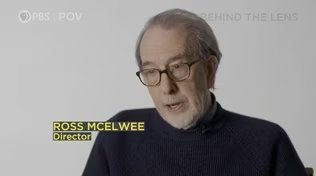
Clip: S39 Ep6 | 1m 20s | Behind the Lens interview with Remake director Ross McElwee. (1m 20s)
Video has Closed Captions
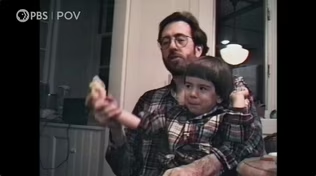
Preview: S39 Ep6 | 2m 4s | Trailer for Remake by director Ross McElwee. (2m 4s)
Providing Support for PBS.org
Learn Moreabout PBS online sponsorship












Support for PBS provided by:
Major funding for POV is provided by PBS, The John D. and Catherine T. MacArthur Foundation, the Wyncote Foundation, Reva & David Logan Foundation, the Open Society Foundations and the...