
Cyberattacks on water systems reported in 7 states
Clip: 8/3/2026 | 6m 32sVideo has Closed Captions
What we know about the cyberattacks on water systems in 7 states
According to the FBI, at least seven states have now been targeted in a growing wave of cyberattacks on critical water infrastructure across the country. Federal officials now reportedly believe Iran is the likely culprit. Liz Landers discussed more with Cynthia Kaiser, a former deputy assistant director of the FBI’s cyber division currently at Halcyon.
Problems playing video? | Closed Captioning Feedback
Problems playing video? | Closed Captioning Feedback
Major corporate funding for the PBS News Hour is provided by BDO, BNSF, Consumer Cellular, American Cruise Lines, and Raymond James. Funding for the PBS NewsHour Weekend is provided by...
Cyberattacks on water systems reported in 7 states
Clip: 8/3/2026 | 6m 32sVideo has Closed Captions
According to the FBI, at least seven states have now been targeted in a growing wave of cyberattacks on critical water infrastructure across the country. Federal officials now reportedly believe Iran is the likely culprit. Liz Landers discussed more with Cynthia Kaiser, a former deputy assistant director of the FBI’s cyber division currently at Halcyon.
Problems playing video? | Closed Captioning Feedback
Where to Watch PBS News Hour
PBS News Hour is available to stream on pbs.org and the PBS app.
Providing Support for PBS.org
Learn Moreabout PBS online sponsorshipAMNA NAWAZ: Well, according to the FBI, at least seven states have now been targeted in a growing wave of cyberattacks on critical water infrastructure across the country.
Federal officials are reportedly investigating Iran as the likely culprit.
Liz Landers has the latest on this story.
LIZ LANDERS: Amna, the coordinated attacks follow urgent warnings issued last month by cybersecurity agencies who said Iran was actively targeting water and energy infrastructure nationwide.
In Minnesota, officials said at least 30 municipal water systems were hit.
Utilities providers across the country are now scrambling to beef up their security.
For more, we're joined by Cynthia Kaiser.
She is former deputy assistant director of the FBI's Cyber Division and a senior vice president at the cybersecurity company Halcyon.
Cynthia, thank you for joining "News Hour."
CYNTHIA KAISER, Former FBI Cyber Deputy Director: Thank you for having me.
LIZ LANDERS: What do we know so far about these attacks?
What kind of damage were they able to do and who is being targeted here?
CYNTHIA KAISER: Attackers have been breaking into the small computers that run America's water system.
In a very small number of cases, there have been some disruptive actions.
Now, FBI and EPA have reported that utilities in at least seven states have known incidents that are of similar kind of severity, which shows just how broad this issue really is.
LIZ LANDERS: So far, federal authorities have not linked this to any specific actor.
Who do you think is behind this attack?
CYNTHIA KAISER: I would be shocked if Iran wasn't behind this attack.
When I was at the FBI, we looked at several different aspects when we were thinking about attribution, especially initially in a campaign.
One was, have we seen this type of targeting recently?
The answer here is yes.
Just a week ago, FBI and CISA, as well as a host of other U.S.
government agencies, put out an urgent warning saying that Iran was continuing to target these mini-computers that control much of our critical infrastructure, including water infrastructure.
The second aspect we looked at on attribution was, do they have a motive to do it now?
Is the attack actually for money or is it for disruptive actions?
This appears focused on disruption, not money.
And, geopolitically, the actor that has the main motive here is Iran.
And then, third, we would look at, who just has a longer history of doing these types of attacks and is willing to cross that red line of targeting critical infrastructure?
The answer here also is Iran.
Going back several years, they have conducted attacks against those these many computers at these facilities, including just kind of stopping at these devices and not going further, which is what's occurring in this operation here.
So we should all be moving forward assuming it's Iran, because there isn't really a plausible other scenario.
LIZ LANDERS: Why would Iran want to target these kinds of municipal water systems?
CYNTHIA KAISER: Iran wants to target these types of municipal water systems because they just want to get into anywhere.
The main aim of these operations is to sow chaos, confusion and fear.
It's to say, we got in somewhere and think about what we could do next.
So when you look at all of these different types of targets, they're going after the ones that they have the ability to get into, and oftentimes that is the smaller municipalities, the smaller locations' water systems because they lack the funding or the I.T.
personnel to be able to fully secure them.
LIZ LANDERS: On Friday, the president blamed the state of Minnesota and its Governor Tim Walz for the attacks, calling them grossly incompetent and corrupt.
Is that a fair criticism?
CYNTHIA KAISER: The FBI itself has noted that at least seven states have been impacted.
And even since Friday, Michigan has come out saying that they have also been victims or at least targeted as a part of this attack.
So it really is broader than the state of Minnesota.
LIZ LANDERS: Just how vulnerable is our country's infrastructure to these sorts of attacks, especially to the local utility systems?
CYNTHIA KAISER: The truth of the matter is that our -- especially our water facilities are very vulnerable to attack.
And that should be scary because everybody depends on water.
When I was in the FBI and policymakers asked me which sector I was most worried about, it was water, because they lack the funding.
They lack the I.T.
personnel necessary.
And they're run by these small municipalities.
They just don't have that full resources, which means the attackers are able to get into something.
It may not be everything, but something within those systems.
And if those systems goes down, we have a lot of problems across our communities.
LIZ LANDERS: The Trump administration has fired nearly a third of the employees at the Cybersecurity and Infrastructure Security Agency, CISA, and they're proposing to cut hundreds of millions of dollars more from the budget next year.
That agency typically maintains those relationships between the state, local, and federal governments and some of the infrastructure of those various places.
Have those cuts impacted the United States' ability to counter these kinds of threats?
Does this worry you?
CYNTHIA KAISER: What I really get worried when we're talking about cuts is not the big events.
Whenever there's been a big event, historically, like, throughout all of these cyber operations, the FBI, CISA, NSA, everybody is able to pull together, push resources towards that and ensure Americans are safe.
But if there aren't additional personnel, what happens to the other types of operations that are happening every day?
What do we miss?
I think that's the first concerning aspect.
But the second doesn't necessarily have to do with CISA at all.
It's the need to renew the funding for state and local cybersecurity grants that all of these municipalities are dependent on to be able to have the right kind of cybersecurity.
It's with the Senate now to act, but it will lapse if it's not renewed by this fall.
LIZ LANDERS: Cynthia Kaiser, thank you for your expertise.
CYNTHIA KAISER: Thank you.
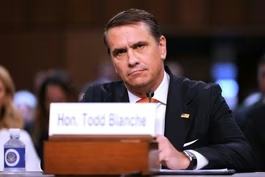
Blanche wins support from GOP holdouts after scrapping fund
Video has Closed Captions
Blanche wins support from GOP holdouts after vowing to scrap 'anti-weaponization fund' (4m 58s)

Michigan Senate primary divides Dems over direction of party
Video has Closed Captions
Contentious Michigan Senate primary divides Democrats over direction of party (7m 50s)
News Wrap: Michigan reports deaths related to cyclosporiasis
Video has Closed Captions
News Wrap: Michigan reports 2 deaths related to cyclosporiasis outbreak (6m 38s)
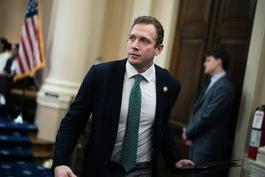
Sen. Moreno calls on ex-son-in-law Rep. Miller to resign
Video has Closed Captions
Sen. Moreno calls on ex-son-in-law Rep. Miller to resign amid domestic abuse allegations (4m 50s)

Tamara Keith and Amy Walter on Democrats not playing it safe
Video has Closed Captions
Tamara Keith and Amy Walter on Democratic primary voters not playing it safe (9m 35s)
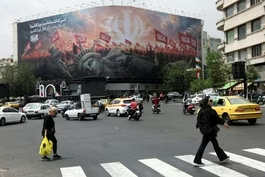
Trump says new talks are Iran's 'last chance' to make deal
Video has Closed Captions
Trump says new talks are Iran's 'last chance' to make deal 'before decapitation' (8m 41s)
Wildfires destroy hundreds of buildings in Washington state
Video has Closed Captions
Wildfires destroy hundreds of buildings, displace tens of thousands in Washington state (3m 8s)
Providing Support for PBS.org
Learn Moreabout PBS online sponsorship New Episode
- News and Public Affairs

Today's top journalists discuss Washington's current political events and public affairs.

- News and Public Affairs

FRONTLINE is investigative journalism that questions, explains and changes our world.
 New Episode
 New Episode
 New Episode
 New Episode
 New Episode
 New Episode
 New Episode
 New Episode
 New Episode
 New Episode
Support for PBS provided by:
Major corporate funding for the PBS News Hour is provided by BDO, BNSF, Consumer Cellular, American Cruise Lines, and Raymond James. Funding for the PBS NewsHour Weekend is provided by...