
Margaret Brown
Season 13 Episode 18 | 26m 46sVideo has Closed Captions
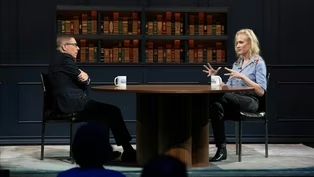
Margaret Brown, director of HBO"s "Yogurt Shop Murders" discusses the long unsolved case.
Margaret Brown, the director of HBO"s "Yogurt Shop Murders" discusses how the cold case was finally solved after more than 30 years, and her career making documentaries.
Problems playing video? | Closed Captioning Feedback
Problems playing video? | Closed Captioning Feedback
Overheard with Evan Smith is a local public television program presented by Austin PBS
Support for Overheard with Evan Smith is provided by: HillCo Partners, Claire & Carl Stuart, Christine & Philip Dial, Eller Group, Diane Land & Steve Adler, and Karey & Chris...
Margaret Brown
Season 13 Episode 18 | 26m 46sVideo has Closed Captions
Margaret Brown, the director of HBO"s "Yogurt Shop Murders" discusses how the cold case was finally solved after more than 30 years, and her career making documentaries.
Problems playing video? | Closed Captioning Feedback
Where to Watch Overheard with Evan Smith
Overheard with Evan Smith is available to stream on pbs.org and the PBS app.
Buy Now
Providing Support for PBS.org
Learn Moreabout PBS online sponsorship- [Announcer] Funding for "Overheard with Evan Smith" comes from HillCo Partners, a Texas government affairs consultancy, Claire and Carl Stuart, Christine and Philip Dial, Eller Group, specializing in crisis management, litigation, and public affairs, communication, ellergroup.com.
Diane Land and Steve Adler.
And Karey and Chris Oddo.
- I'm Evan Smith.
She's an acclaimed documentary filmmaker whose amazing five part mini series on Austin's yogurt shop murders is streaming now on HBO Max.
She's Margaret Brown.
This is "Overheard."
A platform and a voice is a powerful thing.
You really turn the conversation around about what leadership should be about.
Are we blowing this?
Are we doing the thing we shouldn't be doing by giving into the attention junkie?
As an industry, we have an obligation to hold ourselves to the same standards that we hold everybody else to.
This is "Overheard."
(audience applauds and cheers) Margaret Brown, welcome.
It's good to see you.
- It's great to see you.
- Thank you very much for being here.
And congratulations, this is an extraordinary accomplishment, this five part series.
I hope you feel the love that we're sending your way about this.
- It's hard to feel 'cause I was in that world for so long.
And it's a dark world, so, but it does feel good just to get it out there in the world and have people see it.
- Yeah, I wanna do the timeline, our timeline weirdly and Austin, and then do the timeline of the crime and the film kind of together.
The crime in question was December 6th of 1991.
- Yes.
- I moved to Austin two weeks after the crime.
You got to Austin in 1996.
So when you got here, what did you know about the crime?
Or how did you learn about it?
- I mean, I think people just talked about it at parties.
It was sort of in the ether of the city, like a ghost story.
And it was sort of also like a cautionary tale for young women, just, it was scary.
- [Evan] Yeah.
Ghost story in the sense of it being haunting?
- Yeah.
- Like in a literal sense.
Haunting the city and haunting the people who talked about it and thought about it.
And my memory at that time, maybe you remember this also, is that there were billboards up.
- I remember the billboards.
- Right.
- Yeah.
They were kind of like tattered by then, I feel.
But they were around.
And so it was literally hanging over the city.
- Literally hanging over all of us.
And it was an unsolved crime.
So Eliza Thomas, Amy Ayers, Jennifer Harbison, Sarah Harbison, let's say their names, right?
I mean, we always talk about the four girls.
Let's show them the respect to say their names.
13 to 17 years old.
That night in the I Can't Believe It's Yogurt shop.
They were shot execution style, all were sexually assaulted- - All but one, I believe.
- All but one sexually assaulted, the shop was set on fire and the sprinklers went off.
So there was fire damage, there was water.
It kind of made it a hard crime scene to- - Yeah.
There's no way to really fingerprint a flood and a fire.
They tried, but- - This was a horrible, horrific, scary crime.
- The worst thing you can think of happening to someone in your family.
- Right.
And then a couple days later, a kid is picked up at the shopping mall nearby with a gun.
- Yes.
- His name is Maurice Pierce.
- Yes.
- And in the course of him attempting to get himself out of that, we believe, he confesses to this crime.
And he also implicates three of his friends in this crime.
- He doesn't really confess, but he sort of implicates all of them at the scene and- - All four of them.
- Yes.
- Right.
Except he gets details of the crime wrong.
- Correct.
- Right.
And the gun that he has does not match the ballistics from the crime scene.
But the names of the other boys, Morris Pierce is the one who is arrested.
Forrest Wellborn, Michael Scott.
And Robert Springsteen is the fourth one.
Those four are not charged.
- They're a lot off the time.
I mean, I should say that Hector Polanco got confessions from other people too- - [Evan] Say who he was.
- He was a cop at APD who was known for getting confessions.
- [Evan] Austin Police Department.
Right.
- Yes, at Austin Police Department.
- Right.
But a number of people actually had confessed to this.
I mean, one of the great stories of this, "great" stories of this story is the number of people who made false confessions or coerced confessions in the course of the many years that this case was unsolved.
- Right?
- Yes.
- So that's in '20, that pardon me, is in 1991, sort of right after the crime is over.
Then you have to go ahead a couple of years to 1999 when the four who were implicated back then, not charged, their names, come back up into the conversation.
Talk about that.
- Yeah.
A different cop got assigned to the case and he came back to that, and he was able to get confessions out of two of them.
Robert Springsteen and Michael Scott.
- Right.
And those are the two who are ultimately charged and convicted of the crime.
Scott is sent away, life without parole, Springsteen is sent to death row for this crime.
Forrest Wellborn ends up not- - He spent about four months in jail.
- Right.
But he's ultimately no build, as they say.
And Maurice Pierce, interestingly, he's never charged.
- Well, he was held in jail for three years, though.
- But ultimately not- - True.
Yeah.
I mean, but both of them never confessed.
But the confession was all they had.
- And so years passed, as you say, Scott and Springsteen are behind bars, are incarcerated, and then ultimately their convictions are overturned.
- Yes.
The Supreme Court changed like, you couldn't sort of have someone talk, their names had been redacted in the court case.
And so the Supreme Court ruled that you couldn't use that against another person.
So they had both used each other's accounts, even though it was redacted.
So they were both let free.
- Ultimately, they're exonerated of these crimes again.
- Except for the city never really fully exonerated them.
There was still a cloud over all four boys.
- But the point is, the crime is not solved.
I mean- - Correct.
- As much as the, I mean, one of the interesting things about this movie, about this series of episodes and the telling of this story is that it is not so much about the crime as it is about memory, and grief, and trauma, and suffering, and loss.
It's what the families of the victims suffered.
It's what the families of the alleged perpetrators and themselves, what they, the perpetrators themselves suffered over all this time.
- Right, no, I mean, I think it was, so I think the thing that got was interesting to me is that this was something that just touched so many people.
And it wasn't just the family members, but it was also the community was so touched by this, just, I mean, moving here and feeling it so palpably, I can't believe you moved there two weeks later.
I didn't know that.
(chuckles) - Yeah.
- That must have been weird.
But I think I, you know, I don't really work in the world of true crime so much, and in trying to figure out how to tell this story, it was just rabbit hole and rabbit hole and rabbit hole.
But the only thing I could think of that was worth, in a way, hanging my hat on was thinking about how do people deal with the worst thing that could ever happen to you.
Like, is this like, I don't know if this sounds crass, but like an instruction manual in a way to deal with pain and grief, because we all might not as humans have something this awful happened to us, but everyone suffers.
And I think that was what got me through it in a way, thinking something I make might be helpful, to learn how to deal with- - Right.
And ultimately that's what this is about.
It is not a who done it, right?
It's not so much concerned with who did it.
Because, in fact, the first four episodes of this- - Yeah.
We didn't know.
- Yeah.
We don't know who did it.
So let's just say that Maurice Pierce gets into a scuffle with police in 2010, after Scott and Springsteen are released, and he's ultimately killed in the course of that scuffle.
So Maurice Pierce is, he passes in 2010.
Beyond that, this crime remains unsolved.
It's the thing literally and figuratively hanging over the heads of this city and of law enforcement for several decades.
At some point in there, in '21, '22, you come into focus as the director of this film.
What is the origin story of this series, this mini series?
- Well, I think Beth, who's here somewhere.
Beth Garrabrant and her husband, Mickey Stanley, brought, they had just moved to Austin and they brought to their friends Emma Stone and Dave McCarey the story.
And they decided to bring that to A24.
And A24 brought it to HBO and then Beth, Mickey, Emma and Dave brought it to me.
- [Evan] How'd they come to you?
- Through my manager.
- Yeah.
But what was it that interested them about you?
Or was it about it- - You'll have to ask Beth.
- What was it about this project that interested you?
- Well, a few things.
One is that Pamela Colloff, who's sitting in the audience, told me that this is the craziest crime in Texas and there's so many rabbit holes.
And she said this thing.
She said, "You can't tell this story in less than 10 episodes."
And I kind of took that as a challenge, and- - Did you think at any point about it being a more conventional feature length documentary as opposed to a series?
- The job was literally make it in four episodes.
That was the, the network comes to you and says, "This is a limited series."
And then we got the fifth when it got solved.
But I think I also, there was a wealth of archival footage and I saw the footage and it was like watching a real life "Twin Peaks," you know, it was the hair and the vibe of it.
And it was this Austin that was gone now.
- Remember, the Austin of then was a quarter of the size it is now.
And that was- - I didn't live here then.
So to me it was like, looking at this place I'd only thought about but never seen.
So it was very intoxicating in that way.
But then I met the families and it changed for me because thinking in your mind, like, "Oh, I'm gonna tell it like 'Twin Peaks,'" is really different when you then encounter the level of trauma and grief and then it sits in your body in a different way.
And then I was like, "Oh, I can't, I can't."
- It was clear to you what this actually- - It wasn't clear at first.
At first I was still about, I was still like getting, it took a long time to just even get my head around the crime.
Because like I said before, there were so many rabbit holes and there were so many theories.
And the whole just sort of atmosphere of it was pretty overwhelming.
So I didn't really realize it was, and also I was traveling with another movie, so I wasn't even like, fully present, but it wasn't, it was sort of, it took me a minute to realize, no, I have to make it about the thing that was present the day, the first day, my first interview was with Bob Ayers, the father of Amy Ayers.
- [Evan] The father of Amy Ayers.
- And the youngest victim.
And he said to me, I sat down and the first thing he said was how many years, months, days it had been since his daughter had been murdered.
And I remember just feeling in my stomach, like, "Oh," like, "This is gonna," 'cause you feel a presence off of someone of what they're going through.
And I could feel it.
And I realized in that moment, "Well, I don't know what this is yet, but it's not the way I thought."
- Yeah.
You produced this movie over or direct this film over three and a half years.
It takes three and a half years to do, right?
- Yes.
- It premiers at South by Southwest in early 2025.
- Yes.
- Ultimately lands on HBO Max for all of us to see it late summer of August of 2025.
Unbeknownst necessarily to us or to you at the time, this case picks up steam during the years that you're working on the film, because a police detective named Dan Jackson is assigned to the cold case squad in 2022.
And the first day he gets a file and it's the cold case file for the yogurt shop murders.
- I don't know if it's the first day, but- - Well, the lore is that it's the first day.
- It was the first day.
Okay.
- He happens to be right here.
- [Margaret] Yes.
- Right.
(audience and Margaret laughing) - Sorry.
- So he gets the yogurt shop murders cold case file and is working on it over the couple years that you're actually making this film.
- Yes, yes.
- And then in June and July of that summer of '25, he submits a bullet casing to a national database, a bullet casing from a drain in the yogurt shop, on that day, he submits a bullet casing to a national database, and lo and behold gets a hit.
- Yes.
- The case begins to move- - Now I'm feeling like he should be up here, not me, because these are like Dan questions, but yes.
- But ultimately what ends up happening is, they identify through his work and the work that happens after, identify the person who actually did this crime after all these years.
Through both ballistics and DNA on the day of the crime and it's a serial killer.
- So Dan's keeping the secret while the show is coming out and everything and he knows that something might be coming down the pipe.
- [Evan] Right.
- Maybe.
- [Evan] Which is extraordinary.
- Yes.
- [Evan] And then they announced this in September of '25, publicly, four days before the two of you have coffee.
- Yes.
- [Evan] And he hints to you something- - Four days after.
- [Evan] After?
- Yeah.
- Four days after the, but four days.
But this is before it's announced publicly.
He hints to you that something may be coming.
- I don't know if I would call it hinting.
Because what happened is we had coffee 'cause I was about to leave town to work on another movie and we had coffee a lot 'cause we were always talking about it.
And he was in the film.
And there were a lot of times when he would say, "Something might be happening" or, "I might have" like, and so I kind of got used to hearing that.
- But this is different.
- Yeah.
But this time he was fidgety.
He was kind of like, and you know, the kind of like spidey sense of being a filmmaker.
I was like, "Is there something you're not telling me?"
And he's just like, clearly wants to say something, but something was holding him back.
And so I said, "You know I'm leaving with my dog in my car and driving out of town.
Should I call Alice, the producer?
Do I need to get money?"
And he was like, "No, no, you should leave."
And he said, "Because if something happens, I have to tell the families first."
And I was like, "You have to tell the families first.
You've never said that before."
You know, there was like going through my head, but he said I could go.
He said I could go.
So I trusted him because I could tell like, I didn't wanna push him because I could tell he needed to, whatever it was.
And also there, again, there had been so many times he had maybe had something, so I was just gonna let it.
And also I needed to go make another movie.
- [Evan] So you did go.
- [Margaret] I left.
- Then turned around and came back?
- I left my dog with my parents and flew back to Austin.
- Right.
And within a couple days you were shooting a fifth episode of this- - Two days.
- Two days.
To deal with what now turns out to be the resolution of it.
- Yes.
- That fifth episode is amazing.
- [Margaret] Thank you.
- It's emotional to see those now grown men, who've never gonna get their lives back.
Finally at the end of this, and the families.
I mean it really is gripping.
- Thank you.
- Trauma is right.
Ultimately what happened is, the city comes to a settlement with the families of the, a family of Maurice Pierce.
And with the three wrongly accused.
- I think it's still being worked out, but yes.
For $35 million.
- It's amazing.
Well, if people have not seen it, it is an extraordinary accomplishment, these five parts.
And it's a great story.
And even if you think you know the story, you don't.
Why are you a documentary filmmaker and not a feature filmmaker?
- I don't know that I am one or the other.
I think it's that there's something about the adrenaline of documentary filmmaking and sort of waking up.
And I was talking to a friend of mine who's a painter recently, and he said, "Don't you know when you start what something is about?"
And I said, "No, that's actually the thing I love about my job is because if I knew what it was about, why would I even make it?"
- If you were making a traditional Hollywood feature, you probably have a little bit more of a sense on the front end of what it's about.
- Well, maybe, I mean, not if you're John Cassavetes, but I think it depends on what kind of filmmaker you are and how open you are.
But yeah, I would say traditionally narrative films you have a script, you know.
- So you've done four feature length documentaries before the Yogurt Shop Murders, "Be Here To Love Me," the Townes Van Zandt film, one of the great music films of all time, I think.
That was two thousand and... - Four.
Yes.
- And then you do "The Order of Myths," which is about- - Segregated Mardi Gras.
- Segregated Mardi Gras in your hometown of Mobile, Alabama.
That's in 2008.
That one won a Peabody Award.
- Yes.
- Right.
And then you did a film about the BP spill and the aftermath of that Deepwater Horizon that was called "The Great Invisible."
That was in 2014.
- [Margaret] '14.
- That was nominated for an Emmy.
And then you did an extraordinary film called "Descendant" about the descendants of the last slaves on the last slave ship that came over to America, also has an Alabama connection.
- Yes.
- That one was shortlisted for an Academy Award.
Look at you.
(audience laughing) Classic underachiever.
I mean, every one of these films has been like a 10 outta 10.
And that's a very hard thing to pull off.
So I'm just wondering, like, how did it happen?
- I mean, it's because I know Pam Colloff.
(audience laughing) - What has happened over the course of your career?
I mean, you've really picked well, I think good subjects, but also obviously you've executed at an extraordinarily high level.
This is a hard thing to pull off.
- I mean, I think that I have a great team.
I think I would be remiss to say, because I work with the same people over and over.
And we're like a family and they bring themselves fully as people to each project.
And it's kind of, I mean, it's not the same exact people every time.
But I mean, Justin Hennard, who lives here in Austin, I've worked with him.
He's my sound person and I've worked with him.
He's also a great shooter.
Yeah.
I've worked with him since the Townes movie.
- Right.
Well, it takes a village.
And you're very modest and- - No, but I would also- - Generous to give those people.
- Say it's true.
- [Evan] Yeah.
- I would say I have a, I could never, we made that fifth episode, which is an hour and 35 minutes in six months.
I could never do that on my own.
- Right.
Without them.
- There's no way.
Without having a team who's used to working together, who's dedicated to one thing, I remember when we found out that Robert Brashers had been found, Alice Henty, the producer called me and we didn't even know if HBO was giving us money yet.
And she's like, "Whatever happens, I'm in."
Like, that's what my team is like.
They wanna make stuff that, that challenges them and moves them.
- Right.
And every one of those films, I mean several of them, I say two and you argue that the Deepwater Horizon film is also kind of the bayou, so kind of three, are set in the south.
Like there are some narrative threads that go- - And the Townes movie.
- And the Townes movie.
And they all kind of go through them, but there're also different films.
- Yes.
- That's the other thing.
- Yeah.
- Yeah.
- No, I mean, I think that that's the cool thing about documentaries is you don't have to, there's no formula for a documentary.
You can change the rules about what a story is.
And I think that's, you can't get bored if you can keep changing the rules.
- It's a hard time though.
You would acknowledge to do documentary film right now, like, you know, Hollywood- - It's always hard.
- I mean the- - When is it easy?
- Well, there's consolidation in Hollywood.
The streamers have their algorithms that they care about.
- Sure.
- The theatrical releases- - They love that first seven minutes.
- Right.
I mean, yeah.
- Very important.
- Theatrical releases are somewhat determined right now what theaters are gonna show is determined by what's gonna bring in the most money.
There are questions around protections in the First Amendment.
Like documentary film is actually in that conversation about all the infringements upon all of our rights.
Like there is a lot.
It's tough, a tough environment right now.
- [Margaret] Yes.
It's scary.
- Right.
But you're able to get the films that you want to get made, made.
- Sure, today.
I mean, I think the landscape is changing, but I mean, I feel like it's always changing, so it doesn't really scare me.
It probably should scare me.
I mean, a lot of my friends aren't working right now, so that's scary.
- And since we're sitting in a PBS studio, I'll also acknowledge that defunding of public media, which has been a huge financial enabler of documentary film that's yet another- - It's huge.
- Yet another element about this.
- It's just so, in the United States, like, it's not like other countries.
And it's really hard to get funding here.
- Did you know that you wanted to be, regardless of the kind of film, that you wanted to be a filmmaker from the time you were a kid?
- I always knew I wanted to be a storyteller.
'Cause my dad's a songwriter.
And I mean, my mom always tells this story on, in fifth grade, we had some day where I think maybe it was Halloween, but we had to dress up as, oh no, it wasn't Halloween.
It was, we had to dress up like what we wanted to be.
And I dressed up like a writer.
And the way I indicated that was by wearing my clothes all inside out because my dad was so, like, in his own world.
I was like, "Well that must be what being a creative is like," is you're, you know, and I think my shirt's on.
- I think it's on.
- Yeah.
- It's okay.
- Yeah.
- I'm not sure that I've heard that one before.
But that was actually good.
You went to Brown University, you went to NYU film school, got an MFA, and it seems like you were just launched, immediately.
- Didn't feel that way, Evan.
Yeah.
- But look at what you've accomplished though in the short time that you've been doing this.
It's really pretty remarkable.
- Thank you.
I mean, it feels like working, I don't know.
I would like PA on rap videos and I did a lot of, I worked my way up.
But yeah, I mean, I definitely think that, I don't know, growing up in Alabama has its perks.
I seem to keep going back there to mine my hometown- - [Evan] From a story standpoint.
- Yeah.
From a story standpoint.
- [Evan] There's always stuff to do.
- Yeah.
- So in the remaining time we have, you're working on something, but you can't talk about it.
- [Margaret] I can't talk about it.
- Yeah.
Do you typically have one or two, or couple things in the works that you're thinking about?
- Yeah, I mean, it weirdly, like during making the yogurt shop murders, I felt really creatively inspired.
So my next thing is sort of, it has a lot of narrative elements in it.
And I think I'm actually in it too, which I don't know, that's new for me.
So I think that's also what I love about documentary again, is that, you know, that's different than anything I've ever done, so.
- You're in it as kind of the interrogator or the investigator?
- Well, I'm just in it on screen more than any of my other films.
- You are actually the fifth episode of the Yogurt Shop Murders also.
We heard your voice.
- But a voice.
- We heard your voice, but we heard your voice in a way that we really had not- - It's more in the fifth.
Because I think that I am so curious about asking everyone.
'Cause it takes such a turn and everyone feels differently than you think they're going to, it's such a look at like how humans, and I think it made sense to leave my voice in because I think I was sort of the sit-in for the audience who might be having the same thoughts.
- No, I mean, I think that was exactly what I was thinking was I'd be asking that question.
- Yeah, yeah, yeah.
- And I would be reacting to what the person said by asking that follow up question.
So why not actually just have you on camera doing that.
So this thing that you can't talk about, when will we see it?
(audience laughing) - I don't know.
(audience laughing) - Sneaky that you can't answer.
Look, it's nice to see somebody who you respect, and I have enormous respect for you, be successful at what she does and to get the accolades that you've gotten for this.
And so let me just say how glad I am for you and congratulations on your success.
- Oh, thank you.
- Margaret Brown.
Give her a big hand.
(audience applauding) Thank you very much.
- In my mind, it was about three things.
It was about how Dan solved the crime and the kind of intricacies of that, which is sort of like the first 30 minutes of the episode.
The second part is about how the families responded to having something go.
And not just the families like Claire Huie, who's the filmmaker, who's in all first four episodes.
How people, the other previous investigators.
How you go from not knowing to knowing, what that does to your brain.
That was so interesting.
And then the third part of the episode is about what happens to the boys who are wrong.. I shouldn't call them boys, they are men, who are wrongfully accused.
And 'cause that was, when I heard that Robert Brashers was found, that was the first thought I had was about, "What about them?"
(calm music) - [Evan] Visit our website at austinpbs.org/overheard to find invitations to interviews, Q&As with our audience and guests, and an archive of past episodes.
- If you've seen the fifth episode, he had done this to four other people, the same thing except he let them live.
And I think for me, in my mind, like the fact that he had a ruse where he could do that and we know that he did that is pretty convincing to me.
He always worked alone.
- [Announcer] Funding for "Overheard with Evan Smith" comes from HillCo Partners, a Texas government affairs consultancy, Claire and Carl Stuart, Christine and Philip Dial.
Eller Group, specializing in crisis management, litigation and public affairs communication, ellergroup.com.
Diane Land and Steve Adler, and Karey and Chris Oddo.
(calm flute music)
 New
NewVideo has Closed Captions
Clip: S13 Ep18 | 10m 21s | Margaret Brown, director of HBO"s "Yogurt Shop Murders" discusses the long unsolved case. (10m 21s)
Providing Support for PBS.org
Learn Moreabout PBS online sponsorship New Episode
- News and Public Affairs

Top journalists deliver compelling original analysis of the hour's headlines.
 New Episode
- News and Public Affairs

Today's top journalists discuss Washington's current political events and public affairs.
 New Episode
 New Episode
 New Episode
 New Episode
 New Episode
 New Episode
 New Episode
 New Episode
 New Episode
Support for PBS provided by:
Overheard with Evan Smith is a local public television program presented by Austin PBS
Support for Overheard with Evan Smith is provided by: HillCo Partners, Claire & Carl Stuart, Christine & Philip Dial, Eller Group, Diane Land & Steve Adler, and Karey & Chris...