
River of Life
Episode 1 | 49m 27sVideo has Closed Captions
Brave a scorching dry season, then watch river life heat up as the rains arrive.
Avoid scaly and feathery dangers with wallabies, see koolamana lizards battle for mates, and feast with crocodile hatchlings. Brave dangerous rapids and understand the cultural and biological importance of a local river as the rainy season arrives.
Problems playing video? | Closed Captioning Feedback
Problems playing video? | Closed Captioning Feedback
River of Life
Episode 1 | 49m 27sVideo has Closed Captions
Avoid scaly and feathery dangers with wallabies, see koolamana lizards battle for mates, and feast with crocodile hatchlings. Brave dangerous rapids and understand the cultural and biological importance of a local river as the rainy season arrives.
Problems playing video? | Closed Captioning Feedback
Where to Watch The Kimberley: Australia’s Wild West
The Kimberley: Australia’s Wild West is available to stream on pbs.org and the PBS app.
Share Inspiring Moments From The Film
Explore the PBS Giphy collection for The Kimberley.Providing Support for PBS.org
Learn Moreabout PBS online sponsorship[Wind blowing] [Birds calling] [Chick chirping] Narrator: This little bubba is only a few days old.
She doesn't know it, but she's been born into one of the wildest places on Earth.
[Bird squawking in distance] Narrator: For now, she's stuck in this nest, and she's very hungry.
But one day, she'll grow up into a fearsome white-bellied sea eagle.
[Music] And she'll soar over an ancient land full of incredible stories.
♪ [Thunder] ♪ [Thunder] ♪ [Hissing] ♪ [Birds calling] [Music] Narrator: The Kimberley is unique on our planet-- a tropical wilderness that spans over 400,000 square kilometres of north-western Australia, an area almost the size of California.
This is a land defined by its extremes... a wild climate, harsh terrain and remarkable biodiversity... [Hissing] Narrator: with species found nowhere else on Earth.
But this is more than a wilderness.
This is a human landscape, home to the oldest living culture on Earth.
For First Nations people, this land is more than just our home, it's a living, breathing entity.
We call it Country, and we've cared for it for over 50,000 years.
But the Kimberley is now facing threats from near and far, and these new challenges are making life for the animals here even tougher.
♪ Narrator: Following their wild lives through six intense tropical seasons, this is the story of a year in one of Earth's last great tropical wildlands.
[Water splashes] [Growls] [Insects chirping] Narrator: The Kimberley is a land of many moods... and life here is driven by cycles of extreme change.
Many of our First Nations people chart the course of a year in six distinct seasons.
Our seasons are not defined by dates on a calendar, they are defined by what we observe in the natural world.
Right now, it's hot and dry.
[Eagle calling] Narrator: It's the season the Nyikina people of the Kimberley call Lalin.
There's been no rain for six months, and the vast savanna plains are parched.
It's a tough time of year.
At this time of year, the most precious resource of all is what we call wila-- water.
[Cockatoos squawking] Narrator: Thirsty creatures from hundreds of kilometres around gather at the last remaining water.
At first light, agile wallabies make their way down to the river's edge.
[Didgeridoo music] Narrator: Mum and Bubba had it easy when the plains were full of green grass, but the dry season will test them.
If Mum doesn't get water, joey doesn't get milk.
But the river bank's a dangerous place.
Predators are watching.
[Calling] They have bubbas of their own to feed.
And Mum knows it.
She's been here before.
There's eyes in the sky, and there's something in the water.
An ancient predator honed by 200 million years of evolution... [Music] the saltwater crocodile-- the largest and most aggressive reptile on Earth.
♪ Narrator: Anyone who wants a drink... drinks from his river.
But for the wallabies, the sweet promise of fresh water is irresistible.
♪ Narrator: Salties are masters of stealth, and they can hold their breath for over an hour.
♪ ♪ Even little joey's on the lookout... and Mum doesn't waste any time.
The croc you can't see is the one you should be worried about.
♪ ♪ ♪ Narrator: The mob scatters in all directions... and panicked wallabies struggle to scale the crumbling cliffs.
♪ Narrator: One slip and it can all be over.
♪ Narrator: None of his mob can help him now.
This young fella is on his own.
♪ [Growling] Narrator: It's a miraculous escape.
But he's not out of the woods yet.
Sensing an opportunity, the sea eagle moves in.
An exhausted animal is an easy target.
These raptors are powerful predators.
They rarely miss their mark.
♪ Narrator: But this one may have a different plan.
He drives the wallaby back into the water, so the croc can make the kill.
♪ Narrator: Life is tough in the Kimberley, and not everyone survives the dry season.
But for our land's most fearsome predator, Lalin is the season of plenty.
In many First Nations cultures up here, the crocodile is a revered spirit of the riverways.
It plays a vital role in the ecosystem... and symbolizes the raw power of nature.
[Birds screeching] Narrator: Crocs are messy feeders, and it isn't long before the eagle gets his reward.
♪ [Wind blowing] Narrator: The long dry season is a test for all who live in the Kimberley.
But there are signs on the horizon that things are about to change.
[Thunder] Narrator: It starts with a distant rumble of thunder far out to sea.
Then dry lightning storms begin to roll across the land... [Thunder] sparking destructive wildfires, and pushing life to its limits.
The temperature at this time of year can reach well over 40 degrees.
Combined with high humidity, these are deadly conditions.
We call this season Jirrbal, the sweltering buildup to the wet.
But it could still be months before the rain comes.
The season of Jirrbal is a busy time for one of our more iconic residents.
[Hissing] [Loud hissing] Narrator: This little dragon is Gulamana, the frill-necked lizard.
[Hisses] A skilled climber... and an expert of camouflage... Gulamana knows this Country well.
He knows that when the rains begin to fall, the insects will emerge in their millions, and that will give his young ones a good start in life.
But he can't make kids on his own, and if he's hoping to pass on his colorful personality, he'll need to find a lady dragon.
But he's not the only lizard looking for love.
[Hissing] Narrator: In the kingdom of Gulamana, there's fierce competition.
♪ [Squawking] ♪ Narrator: Bragging rights intact, Gulamana has proven his frills aren't just for show.
And the lady lizard likes what she sees.
[Owl hooting] ♪ [Thunder] Narrator: As the season of Jirrbal reaches its peak, the power of the sky is written in the lightning.
[Hissing] Gulamana can read Country, too.
They know the rains are almost here, and when they arrive, there'll be plenty of food for their little ones.
How clever of them to have chosen this moment to lay their eggs.
Two months after mating, our soon-to-be mama dragon looks for somewhere safe, away from the gaze of predators.
[Music] She's chosen a spot near lots of tasty insects and digs a hole in the soft soil.
♪ She won't be here to raise them when they hatch, which is why she takes great care in making her nest.
She leaves behind ten perfect little eggs.
If it's a good place, the right temperature, the right humidity, safe from fire and flood, then in a couple of months, her young ones will arrive into a completely different world... [Music] a green world, perfect for newborn dragons.
[Thunder] Narrator: On the brink of the wet season, what were once isolated electrical storms converge on the horizon... ♪ forming a mountainous cloud bank that roars with thunder.
[Thunder] [Rain pattering] Narrator: The long promise of rain is finally answered by the season of Wilakarra.
It's the moment Country has been waiting for.
The rain quenches the thirst of all our little creatures.
Some animals have developed extraordinary adaptations to survive the long dry.
Burrowing frogs, like this Kimberley spadefoot, have been hiding below the surface in sand soaks.
When the rain seeps into the soil, they dig their way back to the surface and fill the air with their distinctive song.
[High-pitched call] Narrator: It's a song you will hear nowhere else on Earth.
[Music] The torrential rain can last for days on end.
♪ The vital element that we call wila, or water, begins to feed its way through the veins and arteries of the entire landscape... bringing the Kimberley's largest river system roaring back to life.
The Martuwarra, or Fitzroy River, is one of the last great free-flowing river systems on Earth.
It flows uninterrupted for over 700 kilometres through almost pristine deserts, savannas and mountain ranges.
[Birds calling] The Martuwarra has sustained First Nations people in the area for tens of thousands of years, and the return of the wet season is always a happy time for us.
[Children chattering excitedly] Narrator: Local people are a little more careful than the wallabies when choosing where to swim.
[Children laughing] Did you see any cockaroo or what?
I feel one back there.
You feeling rocks.
See if you can find one freshwater mussel.
I'm grab one.
Callum lost it.
That's how I'm grab that stick.
Well, that's a good story, but I want to see the mussel, 'cause I get hungry otherwise.
[Chuckles] My name is Mark Coles Smith.
I'm from the Fitzroy River, the mighty Martuwarra.
I grew up on my mother's Country, where the fresh water meets the salt water.
It's a really beautiful part of the world.
This is, um, this is how I spent a lot of my younger years, jumping around in a lot of the little freshwater pools.
[Kids speaking excitedly] [Birds calling] Mark Coles Smith: There are many nations that make up the length of the Martuwarra.
And all of us have a cultural obligation to protect these waters for future generations.
Despite suffering damage in the last 150 years from European farming, it's still one of the most pristine river systems on Earth.
But in recent times, new threats have begun to emerge.
The Kimberley is being targeted for mining, water extraction and fracking... presenting an imminent existential threat to the river and all life that depends on it.
In response to these growing risks, First Nations leaders of the river have come together to form a coalition of hope called the Martuwarra Fitzroy River Council.
[Music by Mark Coles Smith, as Kalaji, playing] Mark Coles Smith: Our goal is to preserve and advocate for the rights of the river itself.
But in a place this big, that's easier said than done.
Kalaji: ♪ And all this time, I see the water... ♪ Mark: Oh, absolutely spectacular.
Kalaji: ♪ And this life ♪ ♪ Running through the land ♪ We're on our way up into the upper catchment of the Fitzroy River, the mighty Martuwarra... one of the most remote places on Earth.
For several years now, I've worked for the Martuwarra Fitzroy River Council.
I've been on a number of expeditions like this one to promote the natural values of the river.
We can't protect the river if we don't understand how she works and what lives out here.
[Birds squawking] I think when people describe the Kimberleys as some of the most awe-inspiring wilderness in the world, this is some of the stuff they're talking around.
Kalaji: ♪ All this time, I see the water ♪ Mark: Ohhh, look at that.
Kalaji: ♪ And this life ♪ ♪ Running through the land ♪ Mark: The team we got on this expedition is made up of local ecologists and a couple of really experienced white water river guides.
And that's going to help us build as complete a picture as possible of this incredible river system.
Mark Coles Smith: Access is the biggest obstacle to conducting research in the Kimberley.
There are very few roads in the region, and many are impassable during the wet.
The rafts can get into places that even helicopters would struggle to land.
But rafting a river like the Martuwarra at high-water levels has its challenges.
Man: Turn this way!
[Man groans] [Music] [Man whooping] [Bird calling] Mark: Yeah, so this section of the river has a lot of freshwater crocodiles.
They're pretty harmless, but, um... you wouldn't do what we're doing with salties in the river, I'll tell you that.
Mark Coles Smith: Australia is home to two distinct species of crocodile.
The freshwater crocodile found in small creeks and further inland, primarily eat fish and are less aggressive towards humans.
These guys are fast... and will generally only bite people if they get too close.
[Water rushing nearby] Mark: Yeah, looks like we're coming up to this big one.
That big rock in the middle is pretty dangerous.
The water looks like it wants to pull you straight into it.
And you get pinned against something like that, it's going to be a really bad day.
I hope this isn't a sign of what's to come downstream tomorrow.
Could be a bit of a hard slog if this is what we've got further in.
Mark Coles Smith: The Kimberley guards her secrets well, especially in the wet season.
Throughout the season of Wilakarra, heavy rains fill ephemeral wetlands and waterholes.
The sudden and abundant combination of water, heat and sunshine triggers a surge of life.
[Animals calling] Mark Coles Smith: Migratory wetland birds, like brolgas, whistling ducks and magpie geese fly in from all over Northern Australia.
[Birdcalls] Mark Coles Smith: Many come to feast on the tubers of wetland plants.
Others come for the fish.
It's the perfect time to raise young ones.
[Thunder] In the height of the monsoon, baby saltwater crocodiles begin to emerge into the world.
[Thunder] But these little fellas have a long way to go before they're king of the river.
Good thing Mum sticks around to keep a watchful eye on them.
The little ones will feed on insects and small fish... if they can figure out how to catch them.
Life is tough when you're tiny.
Only about one percent of crocodiles survive into adulthood.
Right now, our hatchling is the perfect snack size for larger predators.
[Birds calling] If he wants to be king one day, he'll have to lay low for a little while.
[Insects chirping] Many babies are born at this time of year, and some of the wetland's most specialized inhabitants are just finding their feet.
[Music] The jacana uses its elongated toes to spread its weight over floating vegetation.
This new father has his work cut out.
His freshly-hatched little ones are only about the size of your thumb, and their growing wings are no good for flying yet.
For the first few weeks of their lives, Dad will teach them everything he knows about life on the lily pads.
There's plenty of food out here, if you know where to look.
Spiders, insects, snails, and tiny fish live on and around the lilies.
But there's danger, too.
Below the lilies, there are hungry fish that would love a bite-sized snack.
[Jacana chirps] And high above, the usual suspects are also on the lookout for a tasty appetizer.
[Music] [Birds calling] When Dad senses danger, he calls his babies in, and hides them under his wings, where they all stand very still.
Many predators are triggered by movement, and when you're this small, sometimes the best strategy is to hide in plain sight.
♪ And who wants to eat a ten-legged bird anyway?
♪ [Wind blowing] [Eagle calling] Back on the river, the team are now traveling through some of the oldest rocks on Earth.
And this ancient geology hides incredible biodiversity.
The rugged terrain has kept many of these animals safe from the modern world, but it's also made them hard to study.
Mark: We're going to set up camp here and explore some of the side creeks this evening.
You know, see what animals our ecologist Ian Bool can find.
Mark Coles Smith: Trips like this provide us with opportunities to explore places that may have never been surveyed by Western scientists.
The Kimberley is home to hundreds of plant and animal species that are found nowhere else on Earth.
And new species are discovered all the time.
[Camera shutter clicking] Ecologist Ian Bool has been working in the Kimberley for many years.
Ian Bool: These tributaries hold these beautiful little riparian strips that have got these amazing stands of Pandanus and thickets of figs and Melaleuca.
These are really special places, you know, and not just because of their beauty, but because of the life-giving that it provides to the landscape and the animals around it.
These places are like a refuge and become like the epicenter of life.
During the dry times when the Country is pretty hard for a lot of creatures, these places are really, really important because this is where the water is, the food is, the shade is, the cool.
And as the landscapes change around us, these places are usually really stable.
It allows species to persist, not just through cycles of wet and dry but through deep time.
♪ Mark Coles Smith: During the day, the temperatures out here can become unbearable.
So it's no wonder many animals choose the night life.
[Insects chirping loudly] Mark: So maybe just here on the border, before this-- Man: Is that a laughing frog?
Mark: Over here.
Mark Coles Smith: Even though you can't see as much at night, what you hear is a completely new world.
Documenting these sounds helps us to understand what lives out here.
Mark: There's so many frogs.
[Both laughing] And it can feel like they're right under your feet, and you look and you just... you can't see them anywhere.
[Frogs calling] Ian: My happy place for sure, being out in the bush here and out in the wet.
I've been doing it since I was a little kid, and I love it.
If you walk out into a wetland like this here now and hear so many different species of frog calling, it's a sure sign of a healthy functioning ecosystem.
Each species of frog, you know, has its own call, its own sound.
[Croaking] Ian: So you can identify.
You don't have to go and actually find and see the frog, you can just hear and listen to the biodiversity and know what sort of species live there.
Mark: How many frog species do you think are in this wetland at the moment?
Ian: Probably ten or twelve calling tonight.
[Frogs calling] Mark Coles Smith: There are around 40 species of frog that we know of in the Kimberley, and a quarter of those are found nowhere else on Earth.
[Croaking] Ian: It's certainly a pretty special thing to come to really remote places like this, and you can hear these amazing choruses of sounds.
It's just as noisy as a city, you know, but it's the sounds of nature.
It's magic.
[Owl calling, frogs croaking] Mark Coles Smith: The audio recordings help us document the biodiversity of this region.
[Animals and insects calling] Mark: I think there are tones and harmonics and textures in nature and in the wilderness that are really unique.
And as a sound designer, I draw a lot of inspiration from spending time on Country.
No location is ever the same.
To hear the world, like, as you walk through it is one thing, but then to hear it through, you know, like magnified microphones, like... I think I can hear, like, 100 frogs in my ears right now.
It's--it's pretty, uh, it's pretty incredible.
Mark: It sounds like... one of those laughing frogs, eh?
[Laughing frog calling] Are you laughing at me?
He's like, "What are you doing in the swamp?"
[Laughing frog calling] Mark: I've been listening to Country for a very long time.
I think a part of that listening, the reason behind it is because I care about this Country, and because I love it very much, and because I feel, uh... a deep amount of appreciation that it exists in the complexity and depth and richness that it does.
But I've also grown up in a culture that doesn't just listen to Country, it speaks to Country.
And...and I've tried to share some of the language of that conversation through music.
["Ingidi" by Mark Coles Smith, as Kalaji, playing] Kalaji: ♪ You can see it in the dark now ♪ [Animals calling] ♪ It comes in waves in your heart now ♪ ♪ So big love ♪ ♪ My love ♪ [Animal calls continue] ♪ Mark Coles Smith: The Martuwarra winds its way through extremely remote country.
Expeditions out here can last weeks.
And heavy rains can turn it into one of the largest volume rivers on Earth.
It commands respect.
♪ Man: Whoa!
Mark Coles Smith: The risk of drowning in white water like this is real.
And as the river levels rise, the power of these standing waves grows.
Man: Go, man!
Go, go, go!
♪ [Man inhaling deeply] ♪ Man: Reverse!
Reverse!
[Man gasping for air] Man: Whoo-hoo-hoo!
Mark: That was a bit of carnage.
Um, I think the Martuwarra's keeping us humble.
Um... Which makes sense considering we're doing it in inflatable pack rafts.
It's a lot of water, man.
It's a lot of water.
Mark: Camping here tonight.
This place looks all right, eh?
This looks all right for a campsite.
Got a, uh, beautiful water feature over in the back there.
["Janara" by Mark Coles Smith playing] Mark: Definitely starting to feel the physical wear and tear of traveling along the length of this massive river system.
The longer I spend out here, the more and more my Liyan feels at peace.
Liyan is a Nyikina word for spirit and listening and intuition.
[Music] Mark: As a Nyikina person, we say yi-Martuwarra, which translates as "I belong to the river, but the river doesn't belong to me."
And that's what I've been raised to recognize.
We see a river system as a literal ancestral entity.
It's the cause of countless generations of life for all of our families.
Our legal system and our art systems, our stories and our songs, our medicine and our food is tied to the river.
It has been that way for as long as we could remember.
[Kids speaking excitedly] And so I can't fathom the generations behind me through my mother's family that begin and return to the river.
But that's what I think of whenever I'm out here... the deep time story of the First Nations people of this Country.
Kalaji: ♪ Ooh ♪ ♪ I'm almost home now... ♪ [Thunder] Mark Coles Smith: The wet season comes in waves on Country.
These huge monsoonal troughs drench the landscape and are followed by steamy conditions perfect for insects.
[Insects buzzing and chirping] That means there's loads of food for our soon-to-hatch frill-necked lizards.
Mama Gulamana built her nest with love, and her eggs have remained safe and undisturbed.
The warmth and humidity of Wilakarra has created the perfect conditions for the little ones to grow.
It's been 80 days, and the first baby lizard is beginning to break free.
♪ You can't rush millions of years of evolution.
The hatching process can take days.
♪ But within an hour of leaving the egg, the baby Gulamanas can run, hunt and even practice the cheeky frills they got from Dad.
[Hissing] [Hissing] ♪ These little bubbas will join thousands of other little ones born in the season of Wilakarra.
It's their first day in the Kimberley, and their story is just beginning.
♪ ♪ Ooh ♪ ♪ I'm almost home now... ♪ ♪ Ooh ♪ ♪ I'm almost home now... ♪
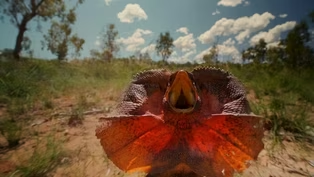
The Mating Ritual of Frilled Lizards
Video has Closed Captions
Clip: Ep1 | 2m 27s | Male frill-necked lizards compete with one another to win the love of a lucky lady dragon. (2m 27s)
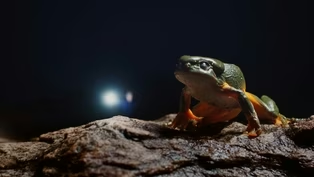
Video has Closed Captions
Clip: Ep1 | 3m 47s | Audio recordings help document the biodiversity and many frogs at night in the Kimberley. (3m 47s)
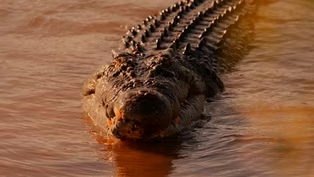
Saltwater Crocodile vs Wallaby
Video has Closed Captions
Clip: Ep1 | 4m 47s | Lacking water in the dry season, wallabies risk it all against the saltwater crocodile. (4m 47s)
Providing Support for PBS.org
Learn Moreabout PBS online sponsorship
- Science and Nature

Explore scientific discoveries on television's most acclaimed science documentary series.

- Science and Nature

Capturing the splendor of the natural world, from the African plains to the Antarctic ice.





 New Episode
Support for PBS provided by: